Every year someone tries to win VPN with a $1.99 monthly headline. The ads look great for two weeks. Then the inbox fills with hotel Wi-Fi tickets, chargebacks, and people who expected a newsroom-grade anonymity product for the price of a coffee. Support does not scale with hope. It scales with minutes, and minutes have a cost.
I price a consumer SKU for Klox: from $2.83 a month, five devices, WireGuard, OpenVPN, OpenConnect, and Shadowsocks in the apps, seven-day money-back. That number is a reference for a finished product with a real refund window. It is not a law for your white-label brand. If you license the platform, you set your price. If you copy the loudest discounter in your language, you also copy their refund culture and their review score.
This piece is about not racing to the floor. I will talk annual versus monthly cash, family framing around five devices, trials that attract professionals, and the ugly math of a ticket that costs more than a month of margin. I will not give you a fake 'optimal price' from a blog survey. I will give you a worksheet you can argue with.
If your model needs 0% refunds and 0% fraud to work, it does not work. Start there.
Related reading: White-Label VPN and Support Macros and White-Label VPN and Billing Churn Margins. How to Start a VPN Business: Complete Guide and VPN Annual vs Monthly Billing: Which Saves Money?. What is a VPN? and Download KloxVPN.
Looking for a reliable VPN?
KloxVPN — from $2.83/month. Apps for every device.
The $1.99 trap
Low prices increase click-through. They also increase the share of users who will never read a help article, will dispute instead of asking, and will churn the first time a streaming IP is hot. You do not get to select only the 'good' cheap users. The channel sends you a mix. At $1.99, a single 15-minute ticket can erase months of that subscriber.
I am not saying expensive is moral. I am saying the floor is set by OpEx: platform or hosting, payments, tax, support, refunds, and the ad you already spent. If you ignore that floor, you are running a traffic experiment, not a brand.
- 1Skim the seating / order diagram.
- 2Do the numbered steps once on your real network.
- 3Use the FAQ if a sentence was too long.
- 4Follow one related article — not ten tabs.
How to read this page
| Monthly effective price | Gross after 8% fees | Tickets per 100 users / month | Cost if ticket = $7 | What is left before ads |
|---|---|---|---|---|
| $1.99 | $1.83 | 12 | $8.40 | Negative before ads |
| $2.83 (Klox consumer reference) | $2.60 | 8 | $5.60 | Still tight if ads are sloppy |
| $4.99 | $4.59 | 6 | $4.20 | Room for a real inbox |
| $8.99 monthly / cheap annual blend | varies | 5 | $3.50 | Typical healthy consumer mix |
A price is a filter. If you filter for people who will not pay for support, do not be shocked when they will not wait for support.
— KloxVPN operator notes
Discount culture is a habit
Once your brand is known for 80% off, nobody pays the number on the pricing page. You will live on countdown timers. Those timers train users to wait, and they train affiliates to only push when a coupon is live. That is a fragile company. I would rather you pick a number you can defend in January and July.
The competitor's billboard is not your cost base
Big consumer VPNs can lose money on the first year and win on year three, or win on other products in the suite. You cannot see their blended CAC. Copying their headline is how small brands donate cash to ad networks. Stack your own numbers. If you cannot, you are not ready to run paid traffic.
What a ticket actually costs
Fully loaded, a competent support minute is not free. Add tools, time off, and the founder minutes you pretend are $0. A messy onboarding flow can generate 0.1 to 0.2 tickets per user per month in the first 90 days. Hotel captive portals and 'connected but nothing loads' never leave. If you sell five devices, you will get five-device tickets: which slot is used, how to drop an old phone, why the tablet still shows the old account.
Price like those tickets exist. Because they do.
Macros cut volume. They do not delete physics.
A good article on public Wi-Fi helps. An AI draft can speed a first reply. Neither one terminates a tunnel or cools a hot IP. If you staff one person for 8,000 bargain subscribers, you will have a graveyard of 48-hour first responses and a one-star chorus. That chorus then raises CAC, which you will try to fix with a deeper discount. That spiral is the $1.99 trap in motion.
Device-limit tickets are a packaging bug
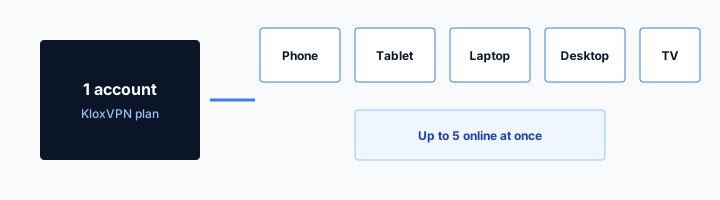
If the site says unlimited and the app says five, you will refund. Klox consumer is five devices. Say it everywhere. If your white-label brand wants a household story, frame five as a family: two phones, a laptop, a tablet, a spare. Do not whisper a sixth device in ads. The store review for that lie is the public one.
Monthly cash versus annual cash
Monthly is honest and expensive to acquire. You will feel churn every 30 days. Annual is a loan from the user. You get cash up front and a longer period before they can leave without thinking. You also get a nastier refund if they bounce in week one, and a nastier chargeback if they forgot. I like a mix: a monthly price that is a bit ugly, an annual that is the intended SKU, and no fake 'you save 94%' math that would fail a fifth-grade check.
We have a separate article on annual versus monthly as a user-facing habit. Here I care about your treasury.

Annual is not free money
If you spend 100% of annual prepaid on ads in the same month, you have no reserve for refunds or a bad hosting month. Hold a slice. I like 20–30% of prepaid sitting as a buffer until the refund window closes. Accountants will have a more precise view. The founder instinct to dump it all into Meta is how you bounce a processor.
Monthly is a quality signal if you can stand it
People who pay monthly and stay are telling you the product works. People who only convert on a two-year checkout might be telling you the coupon worked. Both can be fine. Know which one you are celebrating on the dashboard.
Two-year and three-year plans
Long prepay looks great in a launch week. It also locks you into a price you may regret, and it raises the refund fight when life happens. I would not lead with 36 months on a brand that is eight weeks old. You have no idea what your node map or support load will be.
Five-device family framing
Households are mixed: iOS, Android, a Windows box, maybe a Mac. Five concurrent devices is a product fact on Klox consumer, and it is a pricing story you can tell without inventing 'unlimited' you cannot operate. Unlimited sounds kind. It is how you fund strangers in Discord who share one login across a street.
Frame five as enough for a family that actually lives together. If someone needs a router plus a house full of gadgets, sell a higher SKU or tell them the truth about routers counting as one hop for many devices behind them. Do not invent a router product you do not support.
Concurrency versus seats
Five devices usually means five simultaneous tunnels, not five lifetime activations. Say which. Users will assume the kinder reading. If you wipe old devices from a panel, put that in the help center before they write in anger.
Kids and shared iPads
Family plans fail when one child signs out the parent. Your UX should make the active-device list obvious. This is retention, not a 'feature launch.' It is also how you avoid a ticket that starts with 'I paid and now I am locked out of my own account.'
Your price is not Klox's consumer price
White-label partners set their own rates. That is the point of owning the merchant relationship. Our $2.83 starting point is what we charge for Klox-branded consumer access, with the refund window we publish. You can sit above it if your brand carries language, a niche, or a bundle. You can sit near it if you are honest about being a straightforward client on a shared network. You should not sit far below it unless you have a cost base I do not believe you have.
Reseller is different: you sell Klox at Klox prices (plus whatever the program allows). You do not get to invent a $0.99 Klox SKU on your landing page.
Niche can hold a premium
A regional brand with support in the local language, or an MSP who bundles VPN into a retainer, can charge more than a generic English landing page. The premium is the inbox and the trust, not a new handshake. WireGuard, OpenVPN, OpenConnect, and Shadowsocks are not a moat. Showing up when the tunnel dies can be.
Bundles need a real second product
Password manager plus VPN plus 'AI privacy' in one SKU is how you create four support queues. If you bundle, pick one extra thing you actually operate. Otherwise you are hiding a weak VPN price inside a weaker suite.
Trials, refunds, and adverse selection
Klox consumer uses a seven-day money-back window. That is a policy you can staff. A 30-day window on a $1.99 plan is an invitation to use the product as a free month with extra steps. Require a card if you trial. Rate-limit trial accounts per device fingerprint without pretending that is 'surveillance.' You are stopping farms, not reading traffic.
Refund professionals can smell a new brand. They will test you. A written policy, executed the same way at 11 p.m., is cheaper than founder exceptions that become case law in chargeback land.
Free without a card is a botnet magnet
I will not help you design an open relay. If you insist on a generous trial, put friction on create-account, and watch signup velocity from a single ASN. When it spikes, shut the front door. Revenue is not the only dashboard.
Partial refunds on annual
Decide up front: full refund inside the window, then none, or pro-rata. Pro-rata sounds fair and creates math arguments. Full-then-none is cleaner if the window is short. Publish it. Train it. Do not invent a third policy for a user with 12,000 Twitter followers.
Tax, FX, and 'one number for the planet'
VAT and sales tax will make your pretty $4.99 into $5.99 in some countries if you display inclusive, or into a surprise at checkout if you do not. Pick a display rule and keep it. FX swings will eat a thin margin if you price in one currency and pay hosts in another. This is not protocol work. It is still your P&L.
Purchasing-power differences are real. Localized pricing can be fair and can also become an arbitrage game with extra cards. If you localize, watch VPN-from-checkout patterns that do not match the billing country. That sentence is about fraud, not about moralizing travel.
App Store pricing is a second catalog
If you sell through Apple or Google billing, their price tiers and cuts apply. Your web price and your store price will drift if you do not review them. Users will pick the cheaper path and then ask for the other path's features. Keep a matrix. Assign an owner.
One plan versus a maze
Three SKUs is a product. Nine SKUs is a support script. I like: monthly, annual, maybe a family or extra-device add-on if you truly have one. I do not like 'Lite / Pro / Ultra / Titan' where the only difference is a badge. Users will pick wrong and feel cheated. That feeling becomes a dispute.
If you need a cheap door-buster, make it annual-only and feature-identical, not a crippled client that hides OpenVPN. Crippled clients create tickets that say the product is broken. They are right.
Add-ons should be rare
Dedicated IP, if you offer it, is a real add-on with a real support load (allowlists, mail, banking). Do not invent five add-ons to make the base plan look cheap. That is cable-TV pricing. People hate it, and they are correct.
Lifetime deals will haunt you
A lifetime SKU is a prepay with an infinite service obligation. Hosting prices change. Store policies change. Your partner contract changes. Lifetime users will still be in the inbox in 2029, citing a Product Hunt comment. I would not sell lifetime on a young white-label. If you already did, stop, and honor what you sold without expanding it.
A worksheet you can fill in an hour
Write these numbers before you set a Stripe price. (1) Fully loaded ticket cost. (2) Expected tickets per user in month 1 and month 6. (3) Payment fees plus tax tooling. (4) Refund rate you can live with (I plan 5–10% on a new brand). (5) Chargeback rate that would freeze you (ask your processor). (6) CAC by channel. (7) Platform or hosting per active. (8) A wage for the human who owns the inbox.
Then solve for a monthly effective price that stays positive after (1)–(8) at a CAC you can actually purchase, not the CAC in a guru screenshot.
If you cannot fill three of those eight lines, you are guessing. Guessing is how $1.99 happens: the number came from a competitor's badge, not from a wage and a ticket timer. Fill the lines on a napkin if you must. A napkin with eight numbers beats a slide with a sparkline.
Worked example, conservative
Say ticket cost is $6, month-1 ticket rate is 0.15, fees are 8%, refunds 8% of first-month cash, platform plus overhead is $1.20 per active, and you want $1 left to put toward ads that already happened. You are not in $1.99 land. You are in mid-single-digits monthly effective, with annual doing the cash-flow work. If your ego needs a $1.99 badge, put it on a 24-month plan and do the division in public so you do not look like a liar.
What I will not put in the worksheet
A made-up 'conversion lift from AI chatbot.' Drafts can cut handle time. They do not replace nodes, as the other piece in this series argues. Do not price as if the inbox were free because a model exists.
Raising prices later
You can raise for new checkouts tomorrow. You cannot silently raise a prepaid annual mid-term. Grandfathering is goodwill and a support load ('why did my friend get a different number'). I prefer fewer grandfather SKUs and a clear date. Email people. Do not hide a new number behind a CSS trick.
If you must discount to win a cohort, use a coupon that expires, not a forever SKU you will hate.
Communicating a raise without sounding like a villain
Tell the truth: support and network cost money, and you will not staff a $1.99 inbox. Give existing monthlies a window. Keep the seven-day (or your) refund rule so people who are done can leave cleanly. Rage-quitting users who cannot leave are how you fund chargeback rings.
Affiliates, coupons, and who eats the discount
If you run affiliates, they will ask for a code that undercuts your site. That code becomes the real price. You either publish it or you train users to hunt. I like a single public coupon with a date, or no coupon and a clean number. Evergreen 40% codes are a second price list you will forget to model.
Who pays the affiliate cut matters. If you take it out of an already thin $2 plan, you are paying people to send you tickets you cannot staff. Cap commissions. Kill partners who refund-farm. That is not rude. That is hygiene.
Content partners versus coupon sites
A writer who explains cafe Wi-Fi and then links you is a different animal from a deal aggregator. The first can hold a higher price. The second trains a race. If your entire front door is aggregators, you do not have a brand. You have a SKU on a list. Price like a list and you will be replaced by the next 10% off.
Reseller is not your coupon engine
People in the Klox reseller program send users to Klox prices. Do not hand them a white-label coupon for a brand they do not operate. Mixing motions is how users land in the wrong inbox and the wrong merchant. Keep the programs in separate tabs in your own head.
Refunds after an affiliate conversion
Decide whether clawbacks exist. If an affiliate is paid on checkout and the user refunds on day six, someone eats it. If that someone is always you, the affiliate will optimize for first charge, not for a user who stays. Put the rule in the affiliate terms before the first payout, not after the first fight.
What to publish on the pricing page
Show the real number. Show devices. Show the refund window. Show protocols you actually ship (for a Klox-based brand, WireGuard, OpenVPN, OpenConnect, and Shadowsocks in the apps). Link terms. Do not lead with a struck-through fantasy MSRP nobody paid in this decade. Users are tired. Reviewers of your ads are tired. I am tired.
If you need enterprise lots or a custom contract, that is /contact, not a hidden toggle on a consumer table.
Launch week lies. Month four is when monthly users renew or do not, when annual users still remember they paid, and when your support macros have holes. If you priced for a launch spike, you will feel poor here. Watch net adds after refunds, not gross checkout. Watch ticket minutes per net add. If minutes climb while price stays in the basement, you do not have a marketing problem. You have a staffing problem you sold as a deal.
Honesty as a conversion feature
I would rather a user bounce at $6 than convert at $2 and dispute at $2. The second user is more expensive. Your analytics will not show that if you only watch checkout conversion. Watch refunds and dispute rate in the same weekly review as revenue.
Cohort the refund window
Users who refund on day two are a different story from users who refund on day six after a weekend of 4K. The first is often a bad listing or a failed first connect. The second is often 'I got what I needed.' Your seven-day (or your) window should be staffed for both, but the product fix is different. Do not lower the price to fix a first-connect bug. Fix the client.
When a raise is the support plan
I have told partners to raise $1 on monthly and hire the second inbox person with the difference. That is a better brand than staying cheap and answering in three days. Users who leave over $1 were going to leave over a hotel portal anyway. Users who stay will notice someone answers.
Reseller reminder
If you are in the reseller program, you are not publishing a new VPN price list for the Klox product. You are sending people to Klox. Your money is the program economics, not a $1.99 experiment on our name.
Key Takeaways
Price is a staffing plan with a currency symbol. $1.99 plans fail because tickets, refunds, and fraud do not get the discount. Annual cash helps you live if you do not light it all on ads. Five devices is a family story you can tell without lying about unlimited. White-label means you pick the number; Klox consumer from $2.83 a month is a reference for a complete SKU with a seven-day window, not a script you must copy.
Fill the worksheet. Hold a prepaid buffer. Publish one honest page. If the math only works on a race to the floor, do not launch a brand. Resell Klox, or pick a different product.
When you want to set your own rates on a branded client, talk to us about white-label. Bring the worksheet, not just a coupon idea. If you cannot name your ticket cost, you are not ready to pick a headline number. Name the cost first. The number on the page comes after. I would rather you launch a week later with a number you can staff than launch tomorrow with a number you will hate in month four.
Related Resources
Set a price your inbox can survive
White-label: your brand, your rates, Klox network. Consumer Klox remains from $2.83 a month with five devices and a seven-day window — a reference, not your mandate.
Talk to us about white-labelFrequently Asked Questions
KloxVPN Team
Experts in VPN infrastructure, network security, and online privacy. The KloxVPN team has been building and operating VPN services since 2019, providing consumer and white-label VPN solutions to thousands of users worldwide.