People buy a VPN because a show sits in another country's library, or because hotel Wi-Fi feels like a party line, or because a farm page ranked 'best VPN for Netflix' and sold a feeling. The tunnel can encrypt the hop and change the address the streamer sees. It cannot purchase you a license, rewrite a CDN allowlist, or promise that a shared exit looks like a living room in a specific postcode.
This is not the broad What a VPN Cannot Do list. That piece is anonymity, phishing, backups, 2FA. This is not a Kodi install walkthrough. That guide is device versus router. This is not white-label IP reputation for brands. Here you want a show to play, and I would rather tell you the physics than rank a scoreboard I cannot defend next month.
A VPN is a tunnel to an exit. Wikipedia's virtual private network page is the vocabulary. RFC 8446 is TLS 1.3, which your streaming app already uses for HTTPS. The VPN is an extra hop. It is not Netflix. It is not the BBC. We will not claim a partnership we do not have. We will not invent an unblocking percentage.
KloxVPN is WireGuard, OpenVPN, OpenConnect, and Shadowsocks, five devices, yearly from $2.83 a month, seven-day money-back. If you bought this because one title would not play, use the window. If you bought it to encrypt cafe Wi-Fi and keep a less public IP while you watch something you already have the right to watch, that is the job.
I have a bias. Farm pages that swear a ranked list opens every library are selling affiliate clocks, not catalogs. I will criticize that genre. I will not replace it with a quieter lie.
Related reading: VPN for Kodi: Secure Streaming Setup and Leak Test After You Connect a VPN. Family VPN on Five Devices and What is a VPN?. Download KloxVPN and WireGuard vs OpenVPN.
Looking for a reliable VPN?
KloxVPN — from $2.83/month. Apps for every device.
Streaming is a library problem
The app on your TV asks a company for a file. That company checks an account, a payment, a device, and a guess about where you are. The guess often starts with IP. A VPN changes that guess. It does not change the contract behind the library. If the title is not licensed in the territory the exit appears to be in, the app can still say unavailable. That is not a broken handshake. That is a catalog.
People mash three jobs into one ticket: encrypt the path, look like another country, make this exact show buffer-free. Job one is the product. Job two is a side effect CDNs fight. Job three is last mile and whether the exit is already hated. A guarantee on job two is a sentence no honest consumer VPN should print.
Klox will sell you a tunnel, apps, five device slots, and a week to decide. We will not sell you a Netflix SKU. Pricing is the plan. Download is the client. The rest of this page is what happens after the toggle turns green and the artwork still has a lock on it.

- 1Skim the seating / order diagram.
- 2Do the numbered steps once on your real network.
- 3Use the FAQ if a sentence was too long.
- 4Follow one related article — not ten tabs.
How to read this page
| What you wanted | What the tunnel can do | What it cannot | Honest next step |
|---|---|---|---|
| Watch a title from another country's library | Present a different source IP | Force a license the streamer did not buy | Assume catalogs differ; do not buy a yearly for one episode |
| Stop the hotel from watching your session | Encrypt the hop to the VPN | Fix terrible hotel radios by itself | WireGuard first; OpenVPN if the portal is rude |
| Hide your home IP from a streamer | Exit from the VPN address | Hide the account you logged into | You are still you once you sign in |
| Put the VPN on the TV | Use a device slot, or a router hop | Guarantee the TV OS likes the app | Count the slot; see the five-device seating chart |
| BBC iPlayer while traveling | Sometimes look like a UK exit | Override iPlayer's own checks and license rules | Do not treat iPlayer as a product feature we sell |
| A page that says this VPN unblocks Netflix | Nothing honest | A durable catalog key | Ignore the farm; use the 7-day window if you already paid |
A tunnel does not own a catalog.
— KloxVPN notes
Cloudflare Learning: What is a VPN?
Wikipedia: Virtual private network
Cybernews: Best Netflix VPNs That Still Work (competitor farm specimen)
Logged-in is still you
You signed into the streaming account. Cookies, device IDs, payment region, household profile. The VPN hid the cafe's view of the packets. It did not hide you from the company that already has your email. If you needed anonymity, you bought the wrong story. The broader limits article covers that. Stay here for the show.
Unavailable is not always a VPN fail
The title may not exist in that library. The bitrate may not fit the hotel. The app may have cached a region. Change one thing. Try again. If you change five things and still call it proof the product is fake, you do not have a test. You have a mood.
Geo catalogs: the show lives in a country bucket
Licensors sell territories. Streamers split catalogs to match. That is why a series exists on one country's homepage and not on another's. An exit IP in another country is a hint to their geolocation. Hints get overridden by account home region, payment currency, GPS on a phone, and whatever extra checks they added this quarter.
I will not publish a map of which Klox exit 'unlocks' which library. That map would be stale before the cover image finishes loading. It would also be a promise. We do not make that promise. If a competitor homepage implies they leased Netflix, they did not. If a farm page lists 22 libraries and a 9.7 score, they listed a sales page.
Use the VPN for the hop you can defend: encryption on a network you do not trust, a less public IP. If a catalog looks different after you connect, treat it as weather. Weather changes when a CDN updates a list. I will not print a percentage.
Account region fights the IP
Many apps remember where you paid. Switching the tunnel may do nothing if the profile is pinned. That is the streamer's product. Do not open a Klox ticket titled make my profile American. We cannot.
Travel is the clean story
You already pay for a service at home. You are in a hotel. You want the same app not to dump your session in cleartext on lobby Wi-Fi. That is a VPN job. Wanting a second country's entire shelf as a lifestyle is a different purchase, and an honest vendor will not guarantee it.
CDNs that treat VPN exits as proxies
Streaming is not one server. It is a CDN plus an app plus a license check. CDNs buy feeds of datacenter and VPN ranges. If your exit sits on a range they already tagged, you get a proxy error, an endless spinner, or a captcha that a remote control cannot type. The handshake can be perfect. The overlay can still hate you.
Shared IPv4 makes this worse. You sit behind the same address as strangers. One stranger was noisy. The list does not care. Dedicated IP is a different product and a different article for brands. For you as a consumer, a dedicated SKU may or may not exist on your plan. Do not assume the yearly from $2.83 a month includes a sticky address. Check pricing. I will not invent a SKU.
When the app says proxy, try another location in the picker. Try OpenVPN if WireGuard got you to a hated range. Try a phone hotspot to see if the hotel is the actual villain. Then stop after a short list. An hour of server hopping is how farm pages train you. It is not how you decide whether to keep a subscription.
A successful connect is not a successful play
The client said connected. The artwork loaded. The playhead sat at 0:00. That is a CDN or app decision, not proof WireGuard failed. Check a leak test if you care whether the IP actually changed. The Leak Test After You Connect a VPN checklist is that job. Streaming errors after a real IP change are catalog and blocklist, not a leak.
Do not confuse speed with permission
A fast exit can still be forbidden. A slower OpenVPN TCP session can still be allowed. Permission is not Mbps. I will not quote fake throughput numbers to win a streaming argument.
Shared-IP captchas on the living-room TV
TVs are bad at captchas. Shared VPN exits are good at triggering them. That collision is why living-room streaming through a VPN feels cursed even when the laptop in the same room eventually clicks through. The TV remote is not a browser. The smart TV OS may not show the challenge at all. You get a loop.
This is not the family seating-chart article, but the slot math matters. If the TV takes a device seat and then fails captcha, you burned a slot on a machine that cannot complete the streamer's extra check. Sometimes the honest move is: VPN on the phones and laptops, TV on the home ISP. Sometimes a router hop puts the whole house on one hated IP and then nobody can watch. Pick with that in mind, not with a YouTube thumbnail that says protect your smart TV in one tap.
I would rather you be annoyed at me now than at month four. Captchas on shared exits are normal. They are not a defect unique to Klox. They are not proof the farm page's winner magically made Netflix love datacenter IPv4. That winner is on the same internet.
Phone as a hotspot is a diagnostic
If the show plays on a phone with the VPN on, and the TV fails with the VPN on, you learned the TV path is the problem: app, captcha, or slot. If both fail, you learned the exit or the catalog. One change at a time.
Do not screenshot a captcha at support as a moral failure
We can suggest another location or OpenVPN. We cannot delete you from a CDN's proxy list. Asking us to 'whitelist Netflix' is asking for a partnership we will not claim.
Why we will not promise Netflix
Because we do not control Netflix. We do not have a partnership. We do not have a durable key to their geoblock. Ranges get tagged. Apps update. What played on a Tuesday can fail on a Thursday. A blog that prints still works in 2026 as a ranking is writing fiction on a calendar.
Look at the farm specimen: ranked lists, unblocking as a score, expert-tested. The page exists to send you to a checkout that pays the page. A week of testing is not a contract with you, and it is not a contract with us. We will not print a quieter scoreboard.
If Netflix is the only reason you are here, read this paragraph twice. The tunnel may change what the app believes about your IP. The app may still refuse. If that refusal is a dealbreaker, use the seven-day money-back on a first purchase and walk. I would rather refund you than keep a customer whose only success metric is a catalog we do not own.
No success rate in this post
I will not write 94 percent or any other made-up reliability. If someone quotes a Klox Netflix rate, they did not get it from us. Ask them for the date, the title, the device, and the exit. Then watch it age out.
Store listings will try to make you lie
If you are a white-label founder reading this by accident, do not put unblocks Netflix in the store subtitle. If you are a consumer, treat that subtitle on anyone's listing as a smell. The rejection-patterns article is for brands. You just need to distrust the adjective.
BBC iPlayer and license geography
iPlayer is a UK licence-fee product with its own checks. People treat it like a VPN demo because the errors are blunt. The BBC can ask for more than an IP, and it can change what it asks. A tunnel that looked British yesterday can look like a datacenter today.
We will not promise iPlayer. Same reason as Netflix: we do not own the licence geography, we do not partner with the BBC, and we will not print a pass rate. If you already hold a UK licence and you want encryption on hotel Wi-Fi, that hop is in-scope. If you want iPlayer as a souvenir from another continent, you are asking a consumer VPN to be something else. The product is a tunnel.
Other national catch-up apps work the same way: catalog plus CDN plus extra checks. Do not write us a ticket that is really a licensing complaint for the wrong company.
Error text is not a protocol bug
Location not allowed, proxy detected, please turn off your VPN. Those strings come from the app. Switching WireGuard to OpenVPN might change the exit personality. It might not. Treat it as a try, not as a right.
Do not mix this with unofficial Kodi sources
The Kodi post is how to put a VPN on the same device as Kodi so the hop is encrypted. It is not a list of add-ons. This post will not give you one either. If your plan is unofficial streams, the legal and practical risk is yours, and a VPN is not a pardon.
Five devices and the TV slot
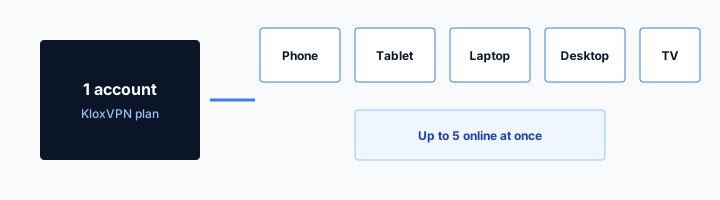
One Klox plan is five simultaneous connections. A TV that runs the app takes a seat. A router hop can take a seat and then cover the TV without a TV app. Both are valid. Both have costs. The Family VPN on Five Devices piece is the seating chart. Here the streaming-specific question is whether the TV deserves a seat if it cannot finish captchas and cannot update the VPN app without a fight.
I would give seats to phones and laptops that leave the house. I would give the TV a seat only if the household actually watches through that app and the TV can run it without weekly archaeology. I would use a router only if you understand you just put every gadget, including the one that cannot show a captcha, on the same exit. Blunt tools feel magical in a YouTube short. They feel less magical at 8pm when a sports stream wants a human checkbox.
Five is the product, not a teaser. If the house needs six concurrent tunnels, you are overbooked. Do not share the password with a neighbor to make six. That is how you get a stranger's traffic on your account during an abuse letter the operator did not ask you to read. Stay inside five. Disconnect ghosts.
Android boxes are still a device
If you sideload or use an Android TV build, it still counts. The Kodi setup guide is the install path. Count the slot before you fall in love with a box that stays connected at 3am.
Ghost sessions kill play night
A tablet asleep with auto-connect still holds a seat. Then the TV cannot join. That is not Netflix blocking you. That is arithmetic. Remove devices in the portal when you retire them.
WireGuard versus OpenVPN when a path is rude
On a normal home or mobile network I want WireGuard. It is the lighter protocol in this stack. Streaming wants throughput. WireGuard usually wastes less of it. That is not a benchmark war. That is why it is the default I tell people to try first.
Hotel captive portals, broken UDP, and some campus networks are rude. OpenVPN, especially TCP, is the spare tire. It can be slower. It can still play a show when WireGuard cannot even finish a handshake. Rude path first, catalog second. If you never get a handshake, you never get to argue with Netflix. The protocol posts exist for white-label operators. You as a consumer only need: try the other one before you decide the product is dead.
I will not tell you OpenVPN unblocks catalogs that WireGuard cannot because of magic headers. Sometimes a different protocol lands you on a different exit personality. Sometimes it does not. If play starts after you switched, you learned that path was rude or that exit was less hated. You did not learn a law of streaming. Note it. Move on.
UDP dies, TCP crawls, the show still might play
A 720p stream on OpenVPN TCP in a hotel is a win if the alternative was no tunnel. Chasing 4K through a spare tire is how you suffer. Turn the bitrate down. Watch the episode. Complain about the hotel, not about AES.
Kill switch versus the splash page
If the kill switch is on, you may never see the hotel portal, so you never get to the VPN, so you never get to the show. Turn it off until you are online, then connect. That is a setup issue, not a catalog issue. The kill-switch explainer is elsewhere. Mentioning it here because streaming tickets hide it.
Seven days if you bought this for one show
Klox consumer money-back is seven days, first purchase, original method. Live details sit on the refund page. If you bought a yearly from $2.83 a month because a farm promised a library, and the title still will not play, do not wait until day 40. Use the window. I would rather you leave than stay angry at a catalog we do not own.
The window is not a free week of 'try every server until Netflix loves you.' It is time to see whether the product you actually bought — encryption, apps, five devices, a less public IP — is useful in your life. If the only useful thing was a show we would not promise, you are in the right to refund. Say that in the ticket. Do not invent a partnership we broke. We did not offer one.
App Store and Play refunds follow store rules if you paid there. Web refunds we can actually issue. The white-label refund-ops essay is for brands. You just need to know which desk owns the money. Then kill the apps so you are not still using five devices after the money moved.
Renewals are not a second seven days
First purchase only on Klox consumer. If you already used the product and you are in month eight of a year, a missing episode is not a refund clock reset. It is a catalog. I know that is cold. It is also the policy.
Do not open a chargeback for a show
If you are inside the window, ask for the refund. A bank dispute over a geo library is how you look like fraud to a processor. Contact support first. That is politeness plus self-defense, not a law.
What a VPN still does well while you watch
Cafe and hotel Wi-Fi. A less obvious IP to random sites. DNS that is not your ISP's marketing resolver, if the app is built that way. A kill switch so a drop does not dump you back onto the lobby. Those are real. They still apply when the thing you are watching is a file you already had the right to watch.
ISPs can see that you connected to a VPN. They should not see the streaming hostname if the tunnel is up and leaks are not leaking. That is worth money to some households. It is not worth a fantasy about every catalog on earth. If that hop is the job you wanted, download the apps and put them on the devices that leave the house. Run a leak test once so you are not guessing.
I still use a VPN when I watch something on a network I do not trust. I do not expect the artwork grid to become a souvenir shop. That expectation is what farm pages sell, and it produces one-star reviews that quote a title and never mention encryption.
Leak tests do not prove a catalog
A pass means this browser, this network, this moment did not show home. It does not mean iPlayer will smile. Do not send a leak screenshot as evidence that a library should open. Different systems.
HTTPS was already on
The streaming app already used TLS. The VPN did not invent encryption for video. It encrypted the path to the exit, including destinations your ISP would otherwise infer. Both can be true. RFC 8446 is the web's TLS. The VPN is the extra hop. You want both. You do not replace one with the other.
Farm pages that rank best VPN for Netflix
You have seen the genre: a numbered list, a winner, a table of libraries, expert-tested, updated 2026. The Cybernews specimen is one. I am linking it as nofollow sponsored so you can see the shape, not so you can shop.
The tell is durable certainty about a moving fight. CDNs update lists. Apps ship detection. Exits burn. A ranking that still knows which provider opens which library this week is either refreshing a lab constantly or writing to an affiliate clock. Neither is a promise you can take to a refund desk when Thursday fails. Our Don't Build Your VPN Brand on Review-Farm Posts is for brands who want to clone that genre. You as a reader should stop treating it as a spec sheet.
If a page cannot say we do not control Netflix, it is not on your side. If it never mentions captchas on a TV, it has not sat on a couch. Try the tunnel for the hop. Use seven days if the only thing you wanted was a catalog.
Affiliate clocks are not lab notebooks
Rank order often follows payout and brand deals as much as playheads. I cannot audit every farm's spreadsheet. I can tell you Klox will not pay its way onto a Netflix scoreboard we refuse to print.
What to do instead of collecting lists
Read What a VPN Cannot Do for the rest of the wish list. Read this page for streaming. Look at pricing. Install from download. Connect. Watch something you already have. See if the hop is worth it. That is the whole method. It is slower than a 9.7 badge. It is also real.
Key Takeaways
A VPN can encrypt the path and change the IP the streamer sees. It cannot own a geo library, beat every CDN proxy list, or type a captcha on a TV. Klox will not promise Netflix or BBC iPlayer. We will not invent a success rate. We will not claim a partnership.
Five devices includes the TV if you give it a seat. WireGuard first, OpenVPN when the path is rude. Yearly from $2.83 a month. Seven-day money-back on first purchase if you bought this for a show and the show did not play.
If you want the hop, get the apps. If you want a catalog guarantee, you are shopping for a sentence we will not print. Farm pages will still print it. They do not have to refund you when Thursday fails.
Related Resources
Buy the hop. Do not buy a catalog myth.
KloxVPN is WireGuard, OpenVPN, OpenConnect, and Shadowsocks, five devices, yearly from $2.83 a month, seven-day money-back on first purchase. Use it to encrypt networks you do not trust. Do not use our pricing page as a Netflix key. We do not have one.
See KloxVPN pricingFrequently Asked Questions
KloxVPN Team
Experts in VPN infrastructure, network security, and online privacy. The KloxVPN team has been building and operating VPN services since 2019, providing consumer and white-label VPN solutions to thousands of users worldwide.