You switched to a different macOS user on a Mac you still own. New local user after a messy year. An Apple ID you finally created because Settings nagged at every lock screen. You logged out of the old login and logged into a new one. The chassis did not leave. You did not wipe the volume. You did not Erase All Content. Apps on the old profile may still sit in that other Dock. The new profile can look empty even though Applications still has yesterday's stuff. Ranked listicles will mash that into a reinstall, Guest User, a Windows user switch, and Sequoia permission notes until the affiliate cookie expires. This page is narrower. Same human. Same chassis. Different macOS login. Per-user leftover.
This is not VPN After a macOS Reinstall: Same Mac, Empty OS, Mac Listing Again. That URL is empty macOS. Apps gone. Network Extension gone. Mac listing again because the volume forgot the binary. Here macOS is still the macOS you had. You changed who sits in System Settings as the signed-in user. A second macOS user is not a reinstall. This is not VPN on a macOS Guest Account: It Wipes. Prefer Your User.. Guest is a chair Apple built to forget you at logout. The home folder dies. You are not in Guest. You created or signed into a named user that still exists tomorrow. A second macOS user is not Guest. This is not VPN When Switching Windows User: Same PC, New Login, Per-User Leftover. That plot is AMD64 or ARM64, an .exe, Run as administrator, a TAP or Wintun-class adapter. Here the OS is macOS. The file is a universal .dmg or .pkg. There is not an architecture picker on the Mac row. This is not VPN on macOS Sequoia: What Actually Changed. Sequoia notes assume the binary is still on disk under the user you already live in and Apple moved the furniture. Here the leftover is the other profile. The new login can miss the menu extra even if Applications still has the app for someone else.
HTTPS already encrypts the page on most of the sites you actually use. The lock in the browser is real. A VPN still wraps the path from this Mac to a server you picked, once a client actually runs under the account you type in. Wikipedia's VPN page is the noun. RFC 8446 is TLS 1.3 on the website. It is not a macOS user. It is not Fast User Switching. Encrypted Client Hello will not copy the menu extra into the new profile. Do not pretend the padlock migrated Klox. Do not pretend Connect is an Apple ID.
KloxVPN is WireGuard, OpenVPN, OpenConnect, and Shadowsocks, five devices, yearly from $2.83 a month, 7-day money-back on first purchase. This Mac still counts as one seat after you sign in again under the account you actually use. Download lists macOS as a universal .dmg or .pkg for Intel and Apple Silicon. Drag to Applications, or run the pkg, under that user if the app is per-user. Enter the admin password when macOS asks. Allow the VPN configuration when macOS asks. Pricing is the live number. The seven-day window is first purchase, not a user-switch coupon. Cookies on this site live at /cookie. I will not invent a city count as a reason the new login is special. I will not invent a portal URL. I will not invent a Mac App Store listing. I will not invent SOC 2.
I have a bias. Type klox.app/download while logged into the macOS user you now live in. Open the Mac listing. Install. Sign into the same Klox email you already paid on. Look at the old macOS user if the menu extra still sits there. Remove a leftover slot in the live app if it still sits. Do not switch a macOS user you do not own. Count the household on the Family VPN on Five Devices if a phone is also holding a session.
Related reading: White-Label VPN and Pkgsrc and What is a VPN?. Android VPN setup and iOS VPN setup.
Looking for a reliable VPN?
KloxVPN — from $2.83/month. Apps for every device.
A second macOS user is not a reinstall and not Guest
A macOS reinstall of a Mac you kept is a different leftover. Applications is empty of Klox. The Network Extension the installer added is gone. First-run macOS does not remember that you paid for a year. That essay already owns the empty volume. Switching the signed-in macOS user leaves the OS standing. The other profile can still have a Dock tile. The new profile can still be missing the client. Farms skip that sentence because the keyword is privacy. Privacy after you meant a new login is a matching Mac listing under that user plus a seat, not a screenshot of Fastest server.
Guest User wipes the home folder at logout on a user Apple built to forget. You are not in Guest. You created a named account, or you signed into one that already existed, on hardware you kept. Mixing those in one sentence is how farms sell best VPN for Mac until the cookie expires. A Windows user switch is AMD64 or ARM64 and an .exe. That essay already owns Win32. This URL is you, alone, moving from one macOS account to another on hardware you kept. The leftover is per-user. The seat is still the machine while Connect is up.
I will not walk packet sniffing. The public Wi-Fi how-to already did. I will not pack your chargers. The travel checklist exists for install-before-you-fly. Here the Mac is already on the desk, same macOS, new login. The download page is the next job if this account cannot see the app. The seat is the job after that. The VPN on Mac: App and Privacy essay is cafe Wi-Fi and App Store versus a website in the abstract. This URL is the per-user leftover. I will point. I will not clone that sermon.
Klox is a consumer tunnel to an exit you picked. It is not Apple's user accounts. It is not Fast User Switching. Apple's set up additional users on Mac page is the vendor novel. I will stay at overview height. I will not paste a 40-click path that rots when Sequoia moves Users and Groups. Farms skip that sentence because the keyword is new user. A new macOS user is Apple's product. Installing Klox under that user is ours.
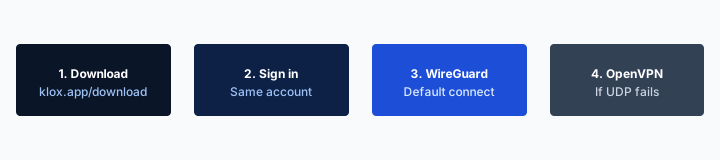
- 1Download the app from klox.app/download — not a random APK site.
- 2Sign in with the account you paid for.
- 3Press WireGuard. Wait for the connected state.
- 4If it fails, try OpenVPN. Still failing: note the network (hotel, campus, home) before you write support.
First successful connect
| Situation | What you think happened | What actually happened | This page? |
|---|---|---|---|
| You reinstalled macOS on YOUR Mac | New macOS user deleted the volume | Apps gone; Network Extension gone; empty OS | Reinstall article |
| macOS Guest User | Temporary chair kept the VPN | Home folder wipes at logout | Guest-account article |
| Windows user switch on YOUR PC | Same old as a Mac user switch | .exe, AMD64 or ARM64, adapter | Windows user-switch article |
| Sequoia permission notes | OS upgrade deleted Klox | App still on disk under this user; furniture moved | Sequoia-notes article |
| YOU switched macOS user on YOUR Mac | The old install followed you automatically | Per-user old; new profile may need the Mac listing | Yes |
| Migration Assistant restore | Same as a new macOS user | Apps can survive; this checklist may not apply | Only if this account cannot see the client |
| macOS user you do not own | A blog ranked privacy | Stop | No. Do not switch it. |
You switched macOS login on a Mac you still own. Get the Mac listing from /download under that user if the app is per-user. Sign in. Remove the old slot in the live app. Do not switch a macOS user you do not own.
— KloxVPN consumer notes
Cloudflare Learning: What is a VPN?
Wikipedia: Virtual private network
Same chassis, different macOS login
Reinstall is empty macOS. Guest is a wipe at logout. Windows user switch is an .exe. Sequoia notes leave the binary sitting under the user you already live in. This URL is a login you created or signed into on hardware you kept. Do not paste one checklist into all five days.
This is not the Guest chair Apple built to forget
Guest User deletes the home folder when you log out. You moving to a named macOS account for yourself is this leftover. OS profiles are not Klox logins in either URL. The install path is. Prefer the named user. Prefer the phone if this chair is temporary.
Per-user leftover: the old account still has the menu extra
macOS stores a lot of what you think of as the app inside the user profile. Dock pins. Desktop aliases. Library containers. Tokens the menu extra used last week. Switch user and those objects stay with the old login. The new desktop can look like first-run macOS even though the disk still has yesterday. People then decide the VPN vanished. It did not vanish. It stayed with the other account. Look before you download twice so two extras fight.
Fast User Switching can keep processes alive. You switch to the new account and the old session is still parked. A tunnel started under Dad can still be up when you land on the new profile, or the other way around, depending on how the helper is scoped. Machine-wide Network Extension versus per-user menu extra is a client fact. Confirm it. Then write it. If the VPN is per-user, the new login does not inherit the extra. If it is machine-wide, the hop can still be up and the household is still spending a seat. Look at the icon. Do not assume.
I will not invent a per-user Klox dashboard so this article matches a competitor screenshot. Klox is one consumer account you sign into on a machine. macOS users are OS profiles. They have their own desktops. They are not extra Klox seats by themselves. They are also not a free extra install if the binary never landed in this profile. Split those two sentences. Farms mash them because the keyword is user.
Log out of macOS is not a Klox disconnect. Closing the session can drop a per-user helper. It can also leave a peer sitting until the handshake dies. Prefer looking in the live app. A leftover row is a corpse, not a second laptop. Remove it there. I will not mint a portal path. A screenshot from a farm is not our admin.
Do not copy files from the old user's Desktop into the new one and call that an install. Aliases break. Tokens stay behind. The honest path is /download under the account you now type in. Drag to Applications, or run the pkg. Sign into the same email. That is boring. Boring is the point.
Fast user switching is not a logout of Klox
The other session can still hold a tunnel. Check the menu extra on both logins if you can still reach the old one. A switch is not Disconnect. Prefer the button in the app.
Log out of macOS is not a Klox disconnect
The OS session died. The account may still show a device row until the handshake dies or you remove it. A macOS log out is not a VPN feature.
Install from /download under the account you actually use
The new profile returns you to a clean Dock. Browser bookmarks are gone unless you signed into a browser profile or iCloud. The old Klox shortcut is on the other desktop. Open a browser you trust while you are this user. Type klox.app/download. Do not search Klox VPN dmg and click the first ad. Ads impersonate download pages. Bookmark download after the first honest visit. Scroll to the Mac listing. Universal build. Intel and Apple Silicon. That is the whole picker. You do not open About This Mac to choose AMD64 versus ARM64 the way Windows makes you. The binary covers both.
Two files sit on that row. Disk image, .dmg. Installer, .pkg. For the dmg: double-click to mount, then drag KloxVPN to Applications. For the pkg: double-click and follow the installer. Launch from Applications. Enter your admin password when macOS asks. Sign into the same email you already paid on. A second Klox account is how you lose the year you already bought and then hit a seat error on the old login you forgot. System requirements on that page: macOS 10.15 Catalina or later on the requirements list, 2 GB RAM, 150 MB disk, internet, admin password for installation. Trust the live page if a number moved. I will not invent a Mac App Store tile because a new Apple ID would have preferred one.
Gatekeeper may appear on a publisher you have not seen under this profile. That is not automatically malware. It is also not automatically fine. The test is the URL you typed. klox.app/download. Open anyway only if you typed that URL. Do not disable Gatekeeper as a lifestyle. The White-Label VPN and Macos Notarization post is for brands writing macros. You are not writing macros. You are installing one consumer Mac app after a login you meant.
If the old macOS user still has the client and you can still log into it, you can uninstall there after this account works. Do not leave two signed-in extras on one chassis unless you like support tickets that start with I switched user and nothing works. One honest install under the account you live in. Then clean the leftover on the account you left.

Universal .dmg or .pkg still matters on this user
Intel and Apple Silicon use the same Mac listing. Do this under the new login, not from memory of the other profile's USB stick. Renaming the file does not change the binary. Windows still wants AMD64 or ARM64. That is the other article.
A forum DMG is still a different product under a new profile
A fresh macOS user is not a reason to trust a Drive folder. Type the URL. If the filename looks like a codec pack or a VPN booster, you left the path. Trash that first.
If the app is per-user, the other login does not inherit the Network Extension
Some Mac installs land in /Applications and show up for every local user. Some land in the profile and do not. Klox's consumer Mac client is a universal .dmg or .pkg from /download that needs an admin password. After an admin install into /Applications, another user on the same Mac can often launch it. After a per-user leftover, they often cannot. Look. If this account has no Dock tile and no menu extra, install from /download under this account. If this account already has the extra, skip the second copy. Two copies is how Connect looks haunted.
I will not invent an /Applications versus ~/Applications picker as a consumer protocol. The Download page does not offer that as a toggle. The practical test is: logged into this macOS user, can you open Klox? Yes: sign in, allow the VPN configuration if asked, look at the seat. No: type klox.app/download, Mac listing, drag or run the pkg. Do not zip the old user's Library/Containers. Do not rsync a home folder because a forum said roaming was privacy. Home folders are Apple's noun. They are not our installer.
An Apple ID you just created is still a macOS user if you used it to make the login. It is not a Klox SKU. Signing into iCloud does not sign you into Klox. Signing into Klox does not create an Apple ID. Keep those buttons apart. People mash them because both say account. One is the OS. One is the tunnel you paid for.
iCloud sign-in on the same profile can keep the same user folder. That is Apple attaching a store login, not creating a second human. If you still see the same desktop, the same Dock pins, and the same menu extra, this checklist may be the wrong URL. You already have the client. Sign in if the token died. Do not download a second copy so two extras fight. If you created a brand-new local user and left the old one sitting, you are on this page. Two home folders. Two Docks. Maybe one /Applications. Look before you assume the hop followed you.
Do not copy the alias from the other desktop. An alias that points at a path the new user cannot read is a blank icon and a ticket. The installer writes the right ACLs. Your drag-and-drop does not. I have watched people duplicate a .app alias, decide VPNs are broken, and then install a forum DMG. The alias was the whole bug.
Applications versus the other user's home is a look, not a slogan
If Launchpad under this user already opens Klox, you are done with the binary. If it does not, install from /download here. Do not guess from the other profile's wallpaper.
Do not copy the Dock icon from the other desktop
An alias is not an install. Tokens stay in the other Library. Type the URL. Drag or run the matching Mac listing under this login.
This Mac is still one of five seats, not two because you have two macOS users
Timeout is the boring failure. You switched macOS user. You did not disconnect first. The account still shows this laptop for a while. You install under the new login, you connect, and you are at five, or you think you were robbed of a slot. You were not robbed. You left a corpse. Remove it in the live app. I will not invent a web portal URL for that tap. Confirm the client you already signed into. If the row is gone on its own, good. If it sits, disconnect that device from a logged-in client. A label is not a logout. Kick is a logout of that seat. It is still not a second Mac. It is still not a reinstall. The chassis is the same radio wearing two macOS names.
Two macOS accounts are not two Klox seats by themselves. A seat is a live handshake. If the tunnel stays up across Fast User Switching, the household still spent one seat. If the tunnel drops when the first person logs out, the next login has to Connect again. Look at the app. Do not assume. I will not invent a per-user Klox dashboard so this article matches a competitor screenshot. We did not ship that screen on the desktop app.
I will not print a minutes-and-seconds figure for when a dead peer drops. Networks fail closed, fail open, retry. Prefer in-app disconnect before a user switch you plan, so you are not guessing. If you already switched, open Klox on this Mac after install, or on a phone that still has the app, and remove the leftover row. Change the password if you are not sure who held the old macOS login. Password reset is not this article's novel. It is the obvious next move when a machine sat unlocked with two accounts.
Family math lives in the five-device article. I will not rebuild the household spreadsheet. Mac you still own plus phone is the common kit for this URL. After a clean remove, you are back to the ones that are actually tunneled. Ghost sessions are how people think a macOS user switch uses extra licenses. There are no extra licenses. There are leftover peers. Five means five connected at once. You can install in more places.
Yearly from $2.83 a month does not buy a sixth seat while a second macOS login retries a name the server still holds. Seven-day first purchase if you only bought to try a tunnel and you are inside the clock. Refunds: /refund. A user switch is not a refund reason by itself. A user switch is not a first-purchase coupon. If you already had a year, a new local account does not restart that clock.
Two macOS accounts are not two Klox seats by themselves
A seat is a live handshake on this Mac. OS profiles do not mint extra slots. If Connect is up, you spent one. If it dropped, Connect again under the account you use.
A leftover row from the old login is a corpse, not a second Mac
Old name plus new handshake is one radio wearing two labels until you remove the old one. Then this Mac is one seat. Count the phone separately if it is tunneled.
The Network Extension may already exist; Allow is still this user's job
The installer adds a Network Extension so the app can own a tunnel. A reinstall of macOS deletes it. A user switch often does not. The extension can still sit in the list from the old install. First Connect under the new profile may still ask. Allow the VPN configuration. If it asks for an administrator password, that is Apple, not a phishing page inside our installer, as long as you typed klox.app yourself. Don't Allow is how people decide a new macOS user hated VPNs. The product did not hate them. They refused the extension.
I will not invent a System Extension bundle id we do not publish. If the live app offers an Open System Settings button, use that button. Hunting by memory is how people enable the wrong row. Apple currently groups some of this under System Settings, General, Login Items and Extensions. Network Extensions, in Apple's own words, are how you customize networking such as a VPN or a content filter. If System Settings renamed a row by the time you read this, follow the dialog the Klox app opens, not a nested path from a stranger's blog. The Sequoia notes article owns that furniture in full. Here the user-switch line is: this profile may never have seen the prompt. You will see it even if the other user already Allowed it last year.
Do not add a VPN in System Settings and pick IKEv2 or L2TP. That built-in row is not Klox. Two tunnels is how you get none. Apple's Set up a VPN connection on Mac is the vendor IKEv2 story. Protocols remain WireGuard, OpenVPN, OpenConnect, and Shadowsocks. WireGuard first. OpenVPN when UDP is rude. Another VPN leftover can own the extension list if you installed a trial from a banner during first-run of the new account. Uninstall that. Then ours. Two privileged Network Extensions fighting is a support ticket that starts with I switched user and nothing works. Split the jobs. macOS user is Apple. Binary is /download under this login. Allow is the configuration prompt. Protocol is WireGuard unless the cafe is rude.
I will not invent a kext catalog. Consumer Klox is not a kernel extension you toggle in a 2018 screenshot. If a farm tells you to disable System Integrity Protection so a VPN will work, leave the farm. SIP stays on. You wanted a hop. You did not want an open inbound day on a Mac you just logged into.
If Connect works on the old macOS user and fails on the new one, the usual miss is the configuration prompt this profile has not seen, or the .app this profile does not have. Run the installer if macOS never asked. Then Connect. Approve the sheet. First handshake on a network you already trust. Do not debug both logins at once in a cafe.
Don't Allow on the configuration prompt is how Connect fails on the new profile
No Network Extension grant for this user, no tunnel. Open the app again. Let it show the prompt. Allow it. Confirm in the live window that the status is actually connected, not a spinner you stared at.
IKEv2 in System Settings is not a Klox protocol
Klox ships WireGuard, OpenVPN, OpenConnect, and Shadowsocks. A built-in macOS VPN row is a different product. Do not stack it under our menu extra and then ask why both look disconnected.
Reinstall, Guest, Windows user switch, and Sequoia notes are forks
A new macOS user can land you looking at Sequoia furniture once the binary actually runs. The Allow prompt is still the product. Login items versus the menu bar extra still matter. Sleep and wake still confuse UDP. Filters still fight the tunnel. Those paragraphs already live in VPN on macOS Sequoia: What Actually Changed. I will point. I will not reprint the furniture so two URLs compete. This page exists so you remember why you are seeing Allow again: this profile forgot the extension, or never had it, not because Apple renamed a row last autumn.
Guest User is still a wipe at logout. If you switched to a named user and then logged into Guest to 'try the VPN', stop. Prefer your signed-in user. The VPN on a macOS Guest Account: It Wipes. Prefer Your User. article owns that chair. A user switch does not make Guest persistent. A user switch does not mint a Guest SKU. Do not install Klox as Guest and expect it to be there after dinner. A Guest handshake can still count a seat if you signed in. Then the home folder vanishes. Then you file that the new login hated VPNs. The new login did not. You sat in the wrong chair.
A Windows user switch is still not this page. AMD64 versus ARM64. Run as administrator. A virtual adapter Windows asked you to allow. If this chassis dual-boots, that is two articles. Do not grab the Windows .exe because you just read user switch in a forum. You are on macOS until you are not. The VPN When Switching Windows User: Same PC, New Login, Per-User Leftover essay owns Win32. I will point. I will not reprint the architecture picker so two URLs compete.
A wipe you ran is the reinstall article. If you Erase All Content and then created a macOS user, you have two articles. Read both. Do not paste one checklist into both days. Migration Assistant can copy Applications from a Time Machine backup or another Mac. If Klox is still in the Dock after a migration onto this user, this checklist is the wrong URL. You already have the client. Sign in if the token died. Do not download a second copy so two extras fight.
The Chrome extension is on Download as browser-only traffic. After a new macOS user you may only have Safari. The extension is not a Network Extension. Slack and Mail stay in the clear. If you truly only needed that browser, install the extension and be honest about the leftover. For a system tunnel on this Mac, you still need the Mac listing, admin password, Allow. Do not treat the extension as a user-switch recovery SKU.
Do not switch a macOS user you do not own. Work laptop. School image. A friend's Mac you are fixing without asking. Stop. I will not coach a new local admin on a disk that is not yours. I will not coach bypassing FileVault. I will not coach skipping a work or school account. I will not coach a VPN as a cloak for that. If it is employer property, IT owns the accounts. If it is a school device, the AUP still exists. If it is not yours, it is not yours.
A new macOS user can still land you on Sequoia furniture
The Allow prompt is still the product once the binary runs. Sequoia notes own the furniture. This URL is the per-user leftover after you can actually run the file. Follow the live dialog.
Do not switch a macOS user you do not own
Work: IT. School: AUP and maybe MDM forever. Borrowed: ask, uninstall when you leave. Do not install Klox as a workaround. Do not mint a local admin because a blog ranked privacy.
First Connect on a network you already trust, then Sequoia notes
First handshake should happen on home Wi-Fi or Ethernet in the kitchen. Confirm WireGuard comes up. Open a boring site. Then pack. A hotel splash plus a first-ever Network Extension prompt on a new macOS user is how people decide the login hated VPNs. The product did not hate them. The garden raced the tunnel.
Once the Mac app actually runs under this account, the rest of the furniture is Sequoia notes: Allow, login items versus the menu bar, sleep and wake, filters versus the tunnel, WireGuard first, OpenVPN if the network is rude, this Mac is one of five. The cafe habit is the VPN on Mac: App and Privacy essay. I will not reprint those lists so three URLs compete. This page exists so you remember why you are doing the list again: the profile forgot the binary, or never had it.
Smart Connect, if the app shows the row, means connect on untrusted Wi-Fi. A cafe SSID is untrusted. A house SSID you run can be marked however the app lets you. I will not invent a toggle named On Demand. If the row is missing, you have a Connect button. Use the button after the splash, same as any other day. A new macOS user does not mint a special auto-connect.
Do not skip because the app felt slow once. Switch protocol. WireGuard first. OpenVPN when UDP is rude. If both fail on a network you trust, wait. A cafe is not the spare tire for a rude first handshake. A rude first handshake is a reason to stay in the kitchen until a boring site loads through the hop. Cookies on klox.app remain at /cookie. A macOS user switch is not a cookie. A leftover seat is not a cookie. Do not file a cookie ticket because a new profile still showed a peer. That peer is this article. ExpressVPN's Mac download ranking is not your leftover. Download the Mac listing under the account you live in. Count the seats. Leave macOS users you do not own alone.
The old macOS user can stay on the disk. That is allowed. Uninstall Klox there if you will not log into it again, so the menu extra does not surprise the next person who still uses that login. If nobody uses that login, Apple's account list is their product. I will not write a delete-user novel. I will tell you not to delete a profile that still holds files you need. Look at Documents on that user before you feel brave.
Seven days is not a user-switch coupon. First purchase, seven days, /refund. If you already had a year, a new local account does not restart that clock. Same email. Same five seats. Yearly from $2.83 a month on the seats that remain. No city count. No portal URL. Cookie policy at /cookie.
Kitchen first, cafe second
Confirm a boring site through the hop at home under this macOS user. Then travel. A splash plus a fresh Network Extension prompt is a bad first rehearsal. Sequoia notes own the portal pause once the binary runs.
Seven days is not a user-switch coupon
First purchase, seven days, /refund. Not a macOS-user gift. If you already had a year, a new login does not restart that clock. Same email. Same five seats.
Key Takeaways
A macOS user switch on a Mac you still own is the Mac listing from /download under that user if the app is per-user, admin password, Network Extension Allow, then the live app for any leftover slot. Prefer disconnect before a login change you plan. Apple owns the accounts. Klox does not. Universal .dmg or .pkg still matters after you create a local user. Sequoia notes own the taps once the binary runs here.
This is not a macOS reinstall, not Guest User, not a Windows user switch, not Sequoia furniture on a disk that already has the app under the user you live in. A second macOS user is not a reinstall. A second macOS user is not Guest. Do not switch a macOS user you do not own. Do not treat a macOS log out as a Klox logout. Mac you kept plus phone is still the household math. Five means five.
Yearly from $2.83 a month on the seats that remain. Seven-day first purchase if you are inside the clock. No city count. No portal URL. Cookie policy at /cookie. If you wanted an empty volume, that article is next door. If you wanted Guest, a Windows login, or Sequoia notes, those pickers are next door too. If you wanted a hop on the macOS login you now live in, download the Mac listing under that user, approve the extension, and remove the corpse if it still sits.
Related Resources
Install Klox under the macOS user you now live in
KloxVPN is WireGuard, OpenVPN, OpenConnect, and Shadowsocks, five devices, yearly from $2.83 a month, 7-day first-purchase money-back. After you switched macOS user on a Mac you still own, get the universal .dmg or .pkg from /download under that user. Remove leftover slots in the live app.
Download KloxVPNFrequently Asked Questions
KloxVPN Team
Experts in VPN infrastructure, network security, and online privacy. The KloxVPN team has been building and operating VPN services since 2019, providing consumer and white-label VPN solutions to thousands of users worldwide.