I keep getting pitches for an 'AI VPN.' Sometimes that means a chatbot that explains settings. Fine. Sometimes it means the founder thinks a language model is a substitute for exit nodes. That is a category error with a marketing budget.
A VPN is a tunnel. Your device wraps packets, sends them to a server you chose, and the server sends them on. The cafe sees encrypted blobs. The site sees the server's IP. An LLM does none of that. It predicts tokens. It does not terminate WireGuard. It does not hold addresses in 40+ cities. It does not fail closed when a handshake dies on a hotel captive portal.
Klox sells the boring product: apps, WireGuard, OpenVPN, OpenConnect, and Shadowsocks, five devices, from $2.83 a month, seven-day money-back. We also put partner brands on that network, or let people resell Klox. I will use AI drafts in support like any operator who values Tuesday afternoons. I will not pretend a prompt window is a datapath.
If you are building a brand, put money into nodes, clients, and an inbox. Use models as clerks. If someone tells you the clerk replaced the network, they are selling you a demo.
I am writing this in 2026, after a year of decks that treated every product as an agent. VPN did not become text. The physics did not change. The hop is still the hop. If you are tired of hearing that, good. It means you already know, and you can stop paying for slides that pretend otherwise.
Related reading: White-Label VPN and Umbraco on a branded site and White-Label VPN and Umbraco Edge. White-Label VPN and Unifi Exporter and White-Label VPN and Update Prompt Copy. What is a VPN? and Download KloxVPN.
Looking for a reliable VPN?
KloxVPN — from $2.83/month. Apps for every device.
Packets are not prompts
A large language model takes text in and emits text. That is a useful clerk for macros, for first drafts, for searching your own help center. It is not a network interface. Your phone does not get a new source IP because a chatbot said 'you are now secure.' The OS needs a tunnel adapter, keys, a live peer, and routing rules. Those are systems problems. They fail in systems ways: MTU, DNS, IPv6 leaks, a node that ran out of conntrack.
I like models. I do not like category theft. Calling a help bot a VPN is like calling a restaurant critic a kitchen.

- 1Skim the seating / order diagram.
- 2Do the numbered steps once on your real network.
- 3Use the FAQ if a sentence was too long.
- 4Follow one related article — not ten tabs.
How to read this page
| Job | Does an LLM do it? | What does | Failure if you skip it |
|---|---|---|---|
| Terminate a tunnel | No | Client + node (WireGuard / OpenVPN) | Cafe hop stays readable |
| Present an IP in another city | No | Egress network | You have a chat app |
| Fail closed on drop | No | Kill switch / OS routes | Silent leak on wakeup |
| Draft a reset-password reply | Yes, with review | Human + macros | Wrong account deleted |
| Answer a legal demand | No | A person with a process | Over-retention or stonewall |
If the product still works when you unplug the GPU rack and the nodes stay up, the GPU was never the product.
— KloxVPN operator notes
Why I linked a Cloudflare Tunnel video
The YouTube walkthrough (ZvIdFs3M5ic) is about exposing an origin without opening inbound ports the naive way. I am not telling you to replace a consumer VPN with Cloudflare Tunnel, and I am not telling you to build a global edge in a weekend because a thumbnail looked friendly. I am pointing at the opposite lesson: edge and tunnels are operational objects. They have accounts, certificates, failure modes, and a vendor you are trusting. A chatbot does not become that object because you pasted a system prompt.
If you want a consumer VPN brand, you still need client apps and egress IPs. If you want a private origin, that is a different product. Do not mash them together on a landing page.
TLS is not a personality
RFC 8446 describes TLS 1.3. Your control plane and many OpenVPN setups live in that world. A model can summarize the RFC. It cannot negotiate the handshake for a million subscribers or notice when a library pinned something old. Operators notice. Or they get a CVE week.
What a tunnel actually does on cafe Wi-Fi
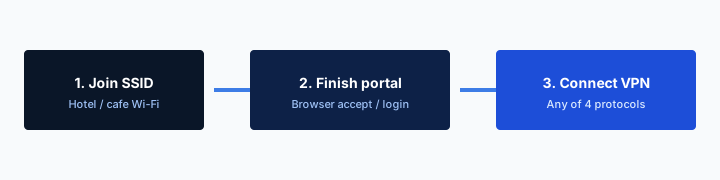
Public Wi-Fi is a shared radio with a gateway you do not run. Without a tunnel, the operator and anyone who can see that hop may read or mess with unencrypted traffic. HTTPS helps a lot for sites that do it right. It does not hide DNS in every setup. It does not hide SNI in every setup. It does not stop a captive portal from being weird. A VPN wraps the path from the device to an egress you chose. That is a concrete change in who sits in the middle.
A chatbot can tell the user to 'be careful on cafe Wi-Fi.' Advice is not a wrap. I still want users to read the advice. I also want the toggle to exist.
I have sat in airports watching people type passwords into hotel portals while a 'privacy assistant' on the same phone offered breathing exercises. That is not a product strategy. Auto-connect on untrusted SSIDs is a product strategy. A kill switch that fails closed is a product strategy. If you cannot ship those, do not spend the brand money on a talking head that explains them in the abstract.
The threat model is a hop, not a vibe
Cafe snooping is not a movie hacker. It is a misconfigured router, a bored neighbor, a malware portal, a hotel that injects. The fix is reducing how much of your session is visible on that hop. That is packets. If your 'AI security app' only nags, the hop is unchanged. Ship a tunnel or do not use the word VPN.
What a VPN does not do, while we are here
It does not make you anonymous to the site you log into. It does not fix a stolen password. It does not bless piracy. It does not replace disk encryption. We have room on this blog for the limits. The chatbot will sometimes forget the limits and invent a superpower. That is why a human still owns the public help center.
Geography is the product people feel
Users pick a city. They want an IP that exists there, with capacity, at 8 p.m. local, that has not been burned by last week's abuser. That is a fleet problem. Forty-plus cities is not a poetic number. It is the minimum shape of a product people will not laugh at when they travel. An LLM has no city. It has a datacenter it does not disclose in the way a VPN must.
If you license white-label, you are putting a brand on a network that already has this unglamorous footprint. If you build, you are in the real-estate business. If you ship a chatbot, you are in the text business. Say which.
Hot IPs and why models cannot rotate them
Streaming and mail providers list datacenter addresses. You rotate, you argue, you pull a node. A language model can write a status page sentence. It cannot provision a new egress or talk to a host about a null route. That ticket still lands on a person with a badge in a portal.
Latency is physics
A user in Lagos connecting to a 'AI optimized' node that is actually one congested VPS in a single region will feel it. Optimization copy does not shrink the ocean. Capacity planning does. I would rather a boring capacity graph than a sparkly 'AI routing' badge with one server behind it.
LLMs as a support clerk
Here is where I am not a scold. Draft the first reply to 'which protocol on hotel Wi-Fi.' Suggest the OpenVPN-over-TCP path. Point at the kill-switch toggle. Summarize the user's last three tickets for the human. That saves minutes. Minutes are money, as the pricing piece says.
Then a human sends it. Because the model will occasionally invent a setting you do not have, or tell someone to disable a kill switch in a way that leaks, or apologize for an outage that is still ongoing. Confidence is not correctness. VPN users treat confident instructions as safe. They are not.
Ground the model in your docs
If you use a bot, retrieve from your help center, not from the open web's pile of outdated WireGuard blog posts. Pin device limits (five on Klox consumer). Pin the refund window (seven days on Klox consumer). Pin what you do not log. If the bot can wander, it will wander into a competitor's feature list and you will look like a liar.
Never let it talk to law enforcement
Abuse and legal mail get a person. Full stop. A model that 'helpfully' attaches logs you do not keep, or that you do keep, is a incident. Ownership of that incident follows the controller, as the customer-ownership piece argues.
Hallucinated configs are a safety bug
I have seen models emit OpenVPN stanzas with the wrong proto, a dead cipher, or a gateway that belongs to a lab. A power user might notice. A founder pasting into a thousand-user config generator might not. If you auto-apply model output to production routing, you have built a chaos monkey and called it innovation.
Treat model output as untrusted input. Validate. Sign configs you ship. Do not let a prompt rewrite iptables on a node.
The 'just generate a WireGuard quick conf' demo
Cute in a workshop. On a phone in the field, you still need distribution, revocation, and a server that exists. A gist is not a control plane. Founders who stop at the gist are why I wrote the build-versus-license money map.
Users will paste secrets into chat
They will paste keys, passwords, support PINs. If your bot vendor trains on that, you created a processor and a leak path. Put a warning. Strip secrets. Prefer in-app diagnostics that do not include keys. This is dull. Dull is how you stay in business.
'AI VPN' as a category error
Some apps wrap a thin client around a model that 'decides' when to connect. If the decision is a simple rule (untrusted SSID), you did not need a 70B parameter model. If the decision is opaque, you created a failure mode you cannot debug at 2 a.m. I like boring rules: untrusted networks auto-connect, kill switch on, user can override.
If your differentiation is a mascot that talks, you still need the tunnel to work when the mascot is down. That is the test. Unplug the model. Do users still get an encrypted hop? If no, you shipped a chat app.
Do not use AI to invent attestations
Models will happily write a SOC 2 paragraph. If you do not have the report, that paragraph is a liability. Same for newsroom trophies you did not earn. I will not write them. Your bot should not either. Put a denylist in the prompt and a human on the security page.
Store review does not care about your model
Apple and Google will still want Network Extension honesty and a Play VPN declaration. A chatbot in the app can add privacy-label rows (the conversation may be personal data). Inventory it. The rejection-patterns piece is the homework. The model will not do the forms.
Failure modes a network has and a bot does not
Nodes die. Hosts null-route. Someone torrents through a shared IP and the whole city gets mail. A protocol library needs a CVE bump. These are VPN operations. A chatbot outage is an inbox problem. Both can happen on the same day. Staff both. Do not staff only the one that demos well in a board slide.
Idempotent deploys, monitoring, and an abuse alias still matter. I sound like a broken SRE. Good. Broken SREs keep packets moving.
Detection
You need to know when handshake success rate drops in a region, not when the bot's sentiment score dips. Instrument the tunnel. Page a human. The model can draft the status tweet after you know the truth.
Recovery
Take a node out. Move DNS or the server list. Push a client that fails over. None of that is a paragraph. It is a runbook. Write the runbook before you write the LinkedIn thread about AI.
Where AI does help a VPN operator
I will be specific so this does not read as a tantrum. Classify tickets. Draft replies from approved macros. Translate a help article. Summarize a postmortem for the team. Suggest a subject line. Flag a burst of similar 'cannot connect in airport X' tickets so you notice a node. That last one is retrieval plus clustering, and it is useful.
Notice what I did not list: generating production keys, auto-changing routes, speaking to a regulator, setting your white-label price, or owning the customer.
Measure handle time, not vibes
If the draft tool does not drop time-to-first-good-reply, turn it off. Tools that make agents edit more than they type are a tax. I have seen both outcomes. The difference is grounding and a short allowlist of topics the bot may touch.
Keep a human on refunds
Refunds and chargebacks are merchant work. A model that issues goodwill credits in a loop is a fraud magnet. Put amounts behind a role. Log who approved. This is the same ownership stack as the merchant-of-record article.
What users still need in 2026
A client that connects. A protocol that survives a hostile network (WireGuard when it can, OpenVPN when it must). A device limit they understand (five on our consumer plan). A price that is not a race to $1.99 if they want an inbox. A refund window you honor (seven days on Klox consumer). A privacy story that matches retention. None of that is a transformer weight.
They may also like a bot that answers at 1 a.m. with a link to the right article. Great. Put it next to the tunnel, not instead of it.
Travel weeks will test you. A user in a new country will pick a far city, hit a hot IP, and write in short angry sentences. The clerk can offer the next city and the OpenVPN fallback. The network has to have that next city. If you only staffed the clerk, you will send a polite paragraph into a brick wall. I would rather you staff the brick wall.
Founders still need a network story
If you white-label, the story is your brand on our network. If you resell, the story is Klox. If you build, the story is your fleet and your calendar. If your story is 'we are ChatGPT but for privacy,' you do not have a VPN company. You have a wrapper. Wrappers get copied in a week. The network story is slower to copy because it costs money every month. That is the point. If it were free, everyone would already have forty cities and a kill switch that works after sleep.
Control plane versus data plane
People mash these together because both have APIs. The data plane is the tunnel: keys, peers, packets, egress. The control plane is accounts, device lists, server lists, payments. A model can sit beside the control plane as a reader of tickets. It should not sit in the data plane as an author of routes. When a founder says 'the AI will pick the fastest server,' I hear 'we will hide a latency probe behind a brand word.' A probe is fine. Calling it intelligence does not make the probe a network.
TLS on the control plane (RFC 8446 again) still matters if the bot fetches account state. You just added a client of your API. Auth it. Rate-limit it. Log it. Do not give it admin.
Read-only is the default privilege
If the clerk can delete users, it will delete users. If it can rotate keys, it will rotate keys at 3 a.m. because a prompt injection in a ticket said so. I am not being cinematic. Prompt injection in support mail is a real class of bug. Least privilege is the fix, not a better adjective in the system prompt.
Server lists are not a chat completion
The list of cities a client shows should come from your signed config, not from a model that 'knows geography.' Models invent towns. Users will tap a city that does not exist and file a ticket that you cannot replay. Ship a list. Sign it. Update it on purpose.
What a white-label sales person may say
Allowed: we use drafting tools so first replies are faster; a human still sends them. Allowed: the product is a VPN on a real network; the bot is optional. Forbidden: 'our AI is the VPN.' Forbidden: 'the model keeps you private.' Privacy comes from the hop and from what you retain, not from a friendly paragraph.
If a prospect wants an AI suite, sell them a suite from someone who owns that suite. Do not bolt a widget onto a tunnel and raise the price $3 with a straight face unless the widget actually cuts their ticket load. Measure it.
Enterprise calls will ask the dumb-smart question
They will ask if the model trains on their traffic. If you do not put user traffic into a model, say so. If a support tool sends ticket text to a vendor, say that, name the vendor, and put it in the processor list. Mixing 'no-logs VPN' with 'we paste your packets into a chatbot' is how you earn a deserved incident. We do not do that. Do not imply we do.
Reseller language is even tighter
You are selling Klox. Do not add an 'AI layer' story we do not ship on the consumer apps. You can use your own clerk for your own first-line mail. You cannot rebrand the protocol stack as a neural net. Users who install Klox should get Klox, not a fan-fiction feature list.
Build the network; draft the replies
That is the whole doctrine. Spend CapEx and OpEx on the path packets take. Spend a smaller, controlled slice on text tools that make the inbox survivable. Do not invert it because a conference stage said every product is now an agent.
When you want a branded client on a real network, talk to us about white-label. When you want to sell Klox as Klox, use reseller. When you want a chatbot only, you do not need us, and I would rather you not use the word VPN in the icon.
A one-line test for your deck
Unplug the model. Do users still get an encrypted hop to an IP you operate or license? If yes, you have a VPN with a clerk. If no, reprint the deck without the tunnel logo.
A one-line test for your inbox
Would you send this draft if it had your name on a legal letterhead? If no, do not send it just because the model was fast.
Key Takeaways
A VPN is a path for packets. An LLM is a path for sentences. You can use the second to staff the first. You cannot use the second as the first. Cafe Wi-Fi does not get safer because a bot wrote a paragraph. Cities do not appear because a prompt said 'global.' Tunnels do not terminate in a context window.
Use models to draft, classify, and translate. Keep humans on legal, refunds, and anything that changes production routing. Keep money on nodes and clients. Klox will keep shipping the boring stack — apps, WireGuard, OpenVPN, OpenConnect, and Shadowsocks, five devices, from $2.83 a month, seven-day money-back — and the partner motions that sit on that stack.
If your launch plan is a chatbot with a lock emoji, stop. If your launch plan is a brand on a network plus a careful clerk, talk to us about white-label. Bring the hop. Leave the sparkle for the status page after the nodes are actually up. A status page with no nodes is a blog. We already have a blog.
I will say this once more because decks keep lying: tokens are not tunnels. The day you treat them as the same object is the day a cafe hop stays readable while your homepage talks about intelligence. Ship the hop.
Related Resources
The product is the hop. The bot is a clerk.
White-label puts your brand on the Klox network. Use AI in the inbox if you want. Do not confuse it with egress.
Talk to us about white-labelFrequently Asked Questions
KloxVPN Team
Experts in VPN infrastructure, network security, and online privacy. The KloxVPN team has been building and operating VPN services since 2019, providing consumer and white-label VPN solutions to thousands of users worldwide.