
Train Wi-Fi is not a cafe with worse coffee and not a cabin at altitude. It is a captive portal bolted to a moving radio, sold by an operator you do not run, often with a thin pipe, a UDP allergy, and a handshake that dies when the train takes a bend. You either finish their page, then start a tunnel, or you sit there with a kill switch fighting a splash you never saw. Ranked listicles will tell you a VPN makes the carriage safe. It does not. It changes what that access point, and whoever operates it, can read about your next hop.
This is not VPN on Airplane Wi-Fi: After the Airline Page, Not Before. The cabin is satellite or air-to-ground and an airline page. Different chair, different altitude. This is not the VPN on Cafe Wi-Fi: A Habit, Not a Superpower. Shops, menus, skip-on-purpose. This is not VPN on Hotel Wi-Fi: Room Number First, Then the Tunnel. Room numbers and paid hours. This is not the VPN Travel Checklist: Before You Go. Install the apps before you leave. This page assumes you already have them. Here the plot is the rails: portal, thin pipe, UDP, roaming between cars, two gadgets, HTTPS leftover, seven days if the trip was the product.
HTTPS already encrypts the page on most of the sites you actually use. The lock in the browser is real. A VPN still wraps the path from your device to a server you picked. Wikipedia's VPN page is the noun. RFC 8446 is TLS 1.3 on the website. It is not a tunnel. The carriage can still see an IP you hop to if you skip the VPN. It can often see a server name if SNI is in the clear. Encrypted Client Hello exists in the industry and is uneven. Do not pretend the lock hid the graph. The remainder is the hop. That remainder is why people open a VPN on train Wi-Fi. It is not a streaming unlock. I will not sell you a catalog I did not promise.
KloxVPN is WireGuard, OpenVPN, OpenConnect, and Shadowsocks, five devices, yearly from $2.83 a month, 7-day money-back on first purchase. Phone plus laptop is two seats. Download is the apps. Pricing is the live number. Smart Connect, if the app shows the row, means connect on untrusted Wi-Fi. Train SSIDs are untrusted. The row can race the splash. If the row is missing, you have a Connect button. Use the button after the page. I will not invent a city count as a reason the window seat is special. I will not invent operator names for the radio in the ceiling. If the portal or the operator's site forbids a VPN, that is their page. Read it. I will not pretend I wrote their contract. Cookies on this site live at /cookie. Their portal cookies are theirs.
I have a bias. Finish their page first. WireGuard next. OpenVPN when UDP dies. Pause the kill switch until you have a route. Skip the SSID if cellular is kinder. Two seats in a row, not five. Seven days if you bought only for this ride. Do not leave fail-closed fighting a portal in a tunnel under a hill and then blame the product.
Related reading: What is a VPN? and WireGuard vs OpenVPN.
Looking for a reliable VPN?
KloxVPN — from $2.83/month. Apps for every device.
Not a cabin, not a cafe
A cafe has a rude AP and a splash. An airplane has that plus a pipe that was never meant to look like home fiber. A train copies both and adds motion. The radio hands off between cars, between trackside cells, between a station AP and whatever is bolted to the carriage. Latency jumps. Loss jumps. Some stacks block UDP because their CGNAT had a bad decade. Cafe advice still helps: get a real route, then tunnel. Cabin advice still helps: the route is thin, the portal is picky. Train advice adds: the handshake you had in car four can die in car five without you standing up.
The packing list is a before-you-leave article. Install Klox on the phone and the laptop while you still have a normal network. Log into the account. Test WireGuard once. Do not discover at a table for two that you never downloaded the Windows build. This page will not walk your toiletries. It will not walk eSIM activation. If your plan is to ignore the train Wi-Fi and use a phone hotspot, that is allowed. Cellular in a valley can still be a toy. I will not pretend every corridor has a perfect cell.
Seatback screens on some coaches are not your laptop. If the carriage has a screen you do not control, you do not install Klox on it. The habit lives on the phone in your hand and the laptop on the table. Those are two of five. The tablet in the overhead is a third if you turn it on and connect.
Farms will rank best VPN for train Wi-Fi until the affiliate cookie expires. I am not competing on city counts. I am competing on whether you get a handshake after the splash without deadlocking the kill switch. That is a smaller claim. It is also the one that matches the product. I will not name the vendor printed on the splash. Operators change. The garden physics do not.
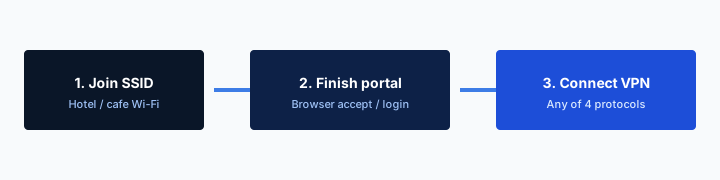
- 1Join the SSID. Do not start the VPN yet.
- 2Open a browser and finish the captive portal.
- 3Open Klox. Connect WireGuard.
- 4If the handshake dies, switch to OpenVPN. Then work.
Do this in order
| Situation | Have a real route yet? | Start the tunnel? | Kill switch |
|---|---|---|---|
| Splash / accept / voucher / seat code | Not until the page finishes | After the page, then yes | Off or paused until a boring site loads |
| Already authenticated this ride | Usually yes, until the radio drops | Yes, WireGuard first | On if you accept hard cuts on drop |
| Messaging-only or captive walled garden | Maybe for a few apps | Often no; the pipe cannot carry a VPN | Irrelevant if you never get a handshake |
| Walked to the next car | Maybe not; you may have a new garden | After a site loads again | Pause if the splash came back |
| Phone plus laptop both on the SSID | Each device separately | Each device is a habit | Per device, two of five seats |
The carriage is a rude portal and a thin pipe. Connect after their page. The next car is allowed to ruin the handshake.
— KloxVPN consumer notes
Cloudflare Learning: What is a VPN?
What this post is not
Not cabin splash at altitude. Not cafe skip-the-menu. Not hotel room numbers. Not a packing list. Not a review of whoever branded the splash. Read those URLs if that is the job. This one is the moving LAN.
I will not name the ceiling radio
Operators and onboard vendors change by country, by franchise, by year. Inventing a brand so this article looks sourced is how you ship a lie. The portal is still a portal. The pipe is still thin.
Portal first, then the tunnel
Train Wi-Fi often wants a click-through, an email, a ticket number, a voucher on a reservation, or an 'I agree' before you have a real route. Same garden as a hotel, worse radio. If Smart Connect or a kill switch fires before the splash, you get no internet and no page. Disconnect. Pause fail-closed if traffic is bricked. Complete the garden. Confirm a boring site. Then connect Klox. WireGuard first. You will be naked on that LAN for a minute. That is the cost of the splash. I will not claim zero exposure.
Some rides keep a cookie so you skip the splash until you change trains. Some re-auth at every major station. If you already have a route, waiting is how mail fetches on their DNS. Connect. Do not perform a portal ritual that is not there. If you are not sure, load a plain site. If it hangs on a login, you are still in the garden.
If the portal or the operator page forbids a VPN, that is their contract. Read it. I will not write a second paragraph that walks around that sentence. Cellular exists. Offline exists. The seven-day window exists if you bought a year for a ride that does not want the hop.
Staff in the buffet car cannot reset your Klox password. They may not even reset the Wi-Fi. Ask for the SSID printed on the tent or the screen. A fake Guest in a carriage full of laptops is still an evil twin. Encryption is not authentication of the train. A tunnel on a twin is still a tunnel to a stranger.
When the portal needs a clear hop
Symptom: Wi-Fi says connected, nothing loads, no login page. Tunnel and fail-closed are the usual culprits. Turn them down, finish the garden, bring them back.
When you already have a route
Cookie stuck from the last station. Then waiting is how mail fetches on train DNS. Connect. Do not perform a portal ritual that is not there.
The pipe is thin
Onboard Wi-Fi is a shared backhaul. Dozens of phones, a few laptops, someone running a call, someone else trying a video. Your tunnel adds overhead. It does not add spectrum. If the pipe was already a toy, Klox will not make it fiber. Farms that promise smooth 4K on a regional service are selling a cookie. I will not.
Use the tunnel for mail, docs, a call you cannot skip. Do not treat the carriage as a download window. If the session is throwaway, skip the SSID and stay on cellular, or stay offline. Skip is allowed. Pretending the VPN is the reason the page crawled is how people protocol-hop for an hour and miss the station.
Speed tests on train Wi-Fi are theater. The path changes while the test runs. A number you got in a station is not the number in a cutting. If you needed an honest speed essay, that URL exists. Here the sentence is: a thin pipe plus a tunnel is still a thin pipe. OpenVPN on TCP will feel worse. It may still be the only handshake that lives.
Battery on a laptop will drain faster if the radio retries and the VPN retries with it. That is physics, not a billing trick. Lower the screen. Kill the test tabs. Cellular hotspot from a phone can be kinder than the ceiling AP. It can also be worse in a tunnel under rock. Try once. Stop if both are toys.

This is not a streaming product
Train Wi-Fi plus a VPN is not a catalog unlock. If a farm said otherwise, they were ranking. Klox is a hop. Use it as that. Buffering is the pipe.
A speed test in a station lies
Wait until you are moving if you insist on testing. Then still distrust the number. The next bend is allowed to ruin it.
UDP dies, OpenVPN next
Klox ships WireGuard, OpenVPN, OpenConnect, and Shadowsocks. WireGuard is the default I want on a normal cafe: fast handshake, light on battery. Train stacks are not a normal cafe. Some hate UDP. Some drop it after a handoff. Handshake hangs, or connects and dies when you leave the station. Then OpenVPN, often TCP, is the spare tire. You will feel it. You will also get a route.
Do not protocol-hop as a personality. One change, test a site, stop. If both fail, it is the portal, the kill switch, or a network that does not want you. Cellular is still a valid train strategy. I use it when the ceiling Wi-Fi is a toy.
DNS through the tunnel still matters on whichever protocol actually connected. IPv6 leak protection still matters if the service hands you a v6 address and your tunnel is v4-only without a block. WebRTC in the browser can still embarrass you to a page you opened. Those are Features-page sentences. They are not a reason to skip WireGuard on the first try. They are a reason to connect, then optionally leak-test if you have the patience, then look out the window.
I will not publish a list of which operators block which ports. That list would be wrong by next season. If WireGuard fails after a real route exists, try OpenVPN. If the client labels TCP, try that. Document the SSID in a ticket if you write in. Do not invent a vendor name so the ticket looks precise.
Carriage APs that hate UDP
Handshake hangs, or connects and dies after a bend. Switch to OpenVPN. If the client labels TCP, try that. Do not sit there fixing Wi-Fi for forty minutes. The AP does not care.
Do not collect protocols as a hobby
WireGuard until it is rude. OpenVPN when it is. Back to WireGuard on the next normal network. Collecting protocols is not a habit. It is fidgeting between stations.
Roaming between cars
You walk to the buffet. The laptop stays on the table, or it comes with you. Either way the radio may associate to a different AP. Some services keep one SSID down the train. Some do not. A new AP can mean a new garden. The splash returns. Kill switch looks like a broken internet. Pause, finish the page again, restore the tunnel. Do not assume the VPN forgot how to handshake. The LAN forgot you.
Roaming while seated still happens. Trackside cells, tunnels, station stops. Fail-closed will cut you more often than at home. That is not a defect in WireGuard. It is a moving building with a shared backhaul. If you cannot live with cuts, skip kill switch on rail days and accept a leak window on drop. That is an adult trade.
Smart Connect, if the row exists, will try to start the tunnel every time the SSID looks new. That races the splash after a car change. Turn it off for the ride if this keeps happening. Use the button after a site loads. Ugly. Works. Turn it back on when you are in a hotel that you understand.
I will not tell you to MAC-spoof, to cling to one AP, or to disable roaming in the OS as a rail hack. That is how you get a stuck association and a worse day. Join, splash, tunnel. When it dies, repeat. Cellular when the repeat is the whole trip.
The splash can come back mid-ride
Session clocks, car changes, a reboot of their gear. Pause kill switch, re-auth, reconnect. Blaming WireGuard for a new garden is how support tickets get written.
Auto that races every new AP
SSID associates, tunnel starts, splash never loads. Disconnect, pause the switch if needed, finish the page, connect. If this is every car, default auto off for the journey.
Phone plus laptop: two of five
A train table is usually two gadgets. Phone already on cellular or already tunneled. Laptop joining the carriage SSID. That is two simultaneous seats if both tunnels are up. Klox is five. You can install in more places. Only five can be connected at once.
The tablet you left at home on auto-connect still counts if it is holding a session. Ghost phones count. A router at home holding a tunnel counts as one seat and then covers a house, which is a different article. For the ride: disconnect what is not in the bag, or live with an error when the sixth handshake tries.
I travel with phone plus laptop. That is the kit. I do not need a family seating chart to know two is two. If a partner's phone also joins, you are at three. Still fine. If a work laptop is a third machine in the same bag, you are at three or four depending on the phone. Count before you sit down, not after the error.
Remove retired devices in the portal. Sleep is not disconnect. A laptop lid can keep a peer. Open the app and look. Do not assume the train is why you hit the cap. The cap is often a tablet on the couch.
Do not leave the tablet holding a seat
Auto-connect on a tablet at home is how you discover the cap on a train. Disconnect it before you leave, or take it off untrusted-only so home Wi-Fi does not keep a tunnel you forgot.
Phone on cellular is one less seat
If the phone stays on cellular, only the laptop needs the carriage habit. That is the usual pattern. Do not tunnel the phone on their SSID just because the laptop did, unless you meant to spend the second seat.
HTTPS already exists
The farm copy still talks as if 2012 HTTP is the default web. It is not. Your bank, your mail web UI, your work chat: TLS. RFC 8446 is how a lot of that encryption works. Contents of the page are not a gift to the person across the aisle running Wireshark for fun.
What the carriage still gets, without a VPN, is the fact of a hop. Destination IP. Often the name in SNI. DNS if your queries are not inside some other encryption. That is a map of who you talked to, not the password you typed into the form. People mash those together because both sound like they can see me. Split them.
A VPN hides that map from the train LAN by making the interesting hop a VPN server. The operator sees encrypted traffic to that server. Ticket logs, cameras in the vestibule: those are not VPN problems. If your threat is a person in the seat, sit differently. If your threat is the LAN, tunnel. If your threat is the site, that is the site.
Klox routes DNS through the tunnel. Features also lists IPv6 leak protection and WebRTC leak blocking. Those matter after you are connected. They are not a reason to skip the splash-page sequence. They are why a connected session is more than HTTPS was on anyway. If you want to verify the session, use a leak-test after connect on a network that is not moving. A train is a poor lab.
What the carriage still sees
Without a tunnel: that you used their AP, roughly how much you transferred, IPs you hop to, often names. With a tunnel: that you used their AP, roughly how much, and a VPN endpoint. They do not get your mail body from that.
SNI and the IP hop
SNI is a name sent while TLS starts. Encrypted Client Hello is rolling out and is not universal. The IP hop remains even when the name is hidden. A tunnel moves both of those to talk to the VPN. That is the honest remainder after you admit HTTPS exists.
One ride and seven days
If you bought Klox only for a week of trains and stations, the consumer window is seven days on first purchase. Live page: /refund. Renewals are not that window. Processing is typically several business days to the original method. Store purchases follow the store.
I would rather you keep the year if you will travel again. Yearly from $2.83 a month is not a buffet-car sandwich. If you will not, refund inside the clock instead of leaving a subscription you resent. Resentment is how chargebacks happen. Chargebacks are a different mess.
Do not buy a month of a farm brand because a best VPN for train list told you to, then also buy Klox, then refund neither. Pick one tunnel. Five devices is enough for a trip kit. WireGuard, OpenVPN, OpenConnect, and Shadowsocks are enough protocols. You do not need a city count to sit in a carriage. You do not need a streaming fairy tale.
If the apps will not handshake on that service even after the splash, try OpenVPN. If they still will not, that is what the seven days are for. Document the SSID in the ticket if you write in. Do not invent an operator name you saw on a sticker. Cellular remains a valid train strategy when the ceiling Wi-Fi is a toy.
First purchase, not a free week forever
The window is so you can try the apps, including on rude Wi-Fi. It is not a coupon for every ride. If you already used a first purchase, you already used the window.
If you only needed this journey
Refund inside seven days if that was the whole product for you. Keep it if trains are a habit you will repeat. Habits are why a year exists. Capes are why farms exist.
Key Takeaways
Train Wi-Fi needs a portal, then a tunnel, not a cabin cape and not a cafe skip. Finish their page. Then connect. HTTPS already locked the page. The carriage still sees the hop unless that hop is a VPN. Skip on purpose when cellular is enough. Do not skip because you forgot, and do not fail-closed through a splash that came back in the next car.
Phone plus laptop is two of five. Smart Connect, if the row exists, is untrusted Wi-Fi. Pause kill switch for the garden and for roaming. WireGuard first. OpenVPN when UDP dies. Seven days if you bought only for one ride. Yearly from $2.83 a month. No city count. No streaming unlock. No invented radio vendor.
If you wanted altitude, the airplane URL is next door. If you wanted a shop, that is cafe. If you wanted a room number, that is hotel. If you wanted a packing list, install before you leave. If you wanted a tunnel you will actually use on a moving LAN, download the apps, practice the splash once at home, and accept that the next car is allowed to drop you.
Related Resources
A carriage is a thin pipe with a splash page
KloxVPN is WireGuard, OpenVPN, OpenConnect, and Shadowsocks, five devices, yearly from $2.83 a month, 7-day first-purchase money-back. Finish their page. Then the tunnel. OpenVPN when UDP dies. Download the apps before you board.
Download KloxVPNFrequently Asked Questions
KloxVPN Team
Experts in VPN infrastructure, network security, and online privacy. The KloxVPN team has been building and operating VPN services since 2019, providing consumer and white-label VPN solutions to thousands of users worldwide.