The loudest VPN ads in 2026 still try to win with a number that looks like a coffee. $1.99. Sometimes $1.49 if the countdown timer is desperate. You can buy that click. You cannot buy a calm inbox with it. The people who convert on a floor price are not a special, grateful tribe. They are a mix: travelers who needed a hotel network for three nights, coupon hunters, and a smaller group who will dispute the charge the first time a streaming IP is hot. Your support load does not care which group they were. Minutes cost the same.
I run a consumer SKU at Klox: WireGuard, OpenVPN, OpenConnect, and Shadowsocks in the apps, five devices, from $2.83 a month on the yearly plan, seven-day money-back. That is a finished product with a refund window we can staff. It is not a law for your white-label brand. If you license the platform, you pick the number on your site. If you copy the cheapest billboard in your language, you also copy the review culture that billboard trained.
This is not another pricing worksheet. We already wrote that. This is about what you stand for when someone is choosing among ten identical-looking tunnels. Position is the story that survives a failed first connect. Price is one line of that story. If the only line you have is 'we are cheaper,' you do not have a brand. You have a SKU that an aggregator will replace next week.
Proof points matter because they are checkable. Five concurrent devices is checkable. Two protocols in the client is checkable. A refund that actually lands in seven days is checkable. 'Military-grade' is not. I will talk about using those proofs as reasons a household or a niche buyer will pay you, without pretending they force your retail price to match ours.
If your plan only works when nobody writes in, it is not a plan. Start with who you want to still be serving after the launch spike dies.
Related reading: Pricing a VPN Brand in 2026 Without Racing to $1.99 and White-Label VPN and Billing Churn Margins. VPN Reseller Margins in 2026 and How to Start a VPN Business: Complete Guide. What is a VPN? and Download KloxVPN.
Looking for a reliable VPN?
KloxVPN — from $2.83/month. Apps for every device.
Cheap is a position. It is just a bad one.
Every brand occupies a slot in the buyer's head whether you designed it or not. Discount VPN occupies 'this might work and I will not cry if I cancel.' That slot is crowded. It is also where chargebacks live. I am not moralizing about money. I am saying the slot comes with a support mix you cannot staff on coffee-money ARPU.
Positioning is the answer to 'why you, if the tunnel looks the same.' The tunnel often does look the same. WireGuard handshakes do not wear your logo. The buyer is guessing based on price, language, refunds, and whether a human answered last time. If you only compete on price, you taught them to ignore the rest.
A virtual private network is a product people notice when it fails. Failures are hotels, captive portals, school Wi-Fi, and 'connected but nothing loads.' Those tickets arrive at every price. At $1.99 they arrive with less cash to pay the person who answers.

- 1Skim the seating / order diagram.
- 2Do the numbered steps once on your real network.
- 3Use the FAQ if a sentence was too long.
- 4Follow one related article — not ten tabs.
How to read this page
| Position you want | What the buyer hears | What the inbox must survive |
|---|---|---|
| Cheapest this week | I will try it and leave | Refunds, disputes, 'it was slow once' |
| Honest household tool | Five devices, I know the limit | Slot fights, old phones, tablet sleep-connect |
| Local-language operator | Someone answers in my language | Hotel Wi-Fi, payment receipts, device list |
| Niche bundle (MSP, ISP) | This is part of a retainer | Who pays, who resets, SLA tickets |
If the only reason to pick you is a dollar, the only reason to leave you is a dollar plus a bad afternoon.
— KloxVPN operator notes
Cloudflare Learning: What is a VPN?
You already have a position on day one
Launch week copy writes itself: fast, private, worldwide. So does everyone else's. The position that sticks is what you do when the first one-star review lands. Do you refund and fix the listing, or do you argue in public? Buyers watch that. Affiliates watch that. I would rather you look slightly expensive and boring than cheap and chaotic.
Aggregators will flatten you
Coupon sites sort by discount depth. If that is your front door, you are a row. Rows get replaced. A brand that owns a language, a niche, or a household story can still show up on those sites, but it should not live there. Price like a row and you will be treated like a row.
What a $1.99 race does to support
Low price increases click-through. It also increases the share of users who will not read a help article. They want a human, now, and they want a streaming catalog that a shared IP cannot promise. You do not get to filter for 'good cheap users.' The channel sends a mix.
A ticket that takes fifteen minutes can erase months of a bargain plan. That is not a metaphor. Fully loaded support time is rent, tools, and the founder minutes you pretend are free. If your ads celebrate $1.99, your review score will eventually describe the wait. The wait is the product they remember.
I have watched new brands try to fix this with a chatbot. Drafts can speed a first reply. They cannot terminate a tunnel or cool a hot IP. Position as 'we answer' only if a human still owns the hard tickets.
Adverse selection is not a vibe. It is a mix.
Cheap plans attract people testing ten VPNs in a week. They also attract people who genuinely cannot pay more. You cannot tell them apart at checkout. You can tell them apart in refund timing and in how they talk to support. Staff for the mix. If you cannot, do not buy the mix with a floor price.
One-star reviews are a CAC tax
Paid traffic gets more expensive when the store listing looks angry. Brands then 'fix' CAC with a deeper coupon. That is the race in motion. The honest fix is fewer tickets per user and a price that pays for the inbox. Unromantic. It works.
Hotel Wi-Fi does not care what you charged
Captive portals, DNS that lies, and 'connected but nothing loads' show up at every ARPU. If your position is cheapest, you still owe a macro and a human for that ticket. Budget it. Or stop pretending the protocol page is the business.
Proof points you can price against, not copy as a mandate
Klox consumer is five devices, WireGuard, OpenVPN, OpenConnect, and Shadowsocks, from $2.83 a month, seven-day money-back. Those are facts about our SKU. A white-label partner can charge more if the brand carries language, a bundle, or an MSP retainer. A partner can sit near that number if they are honest about being a straightforward client on a shared network. A partner should not sit far below it unless they have a cost base I do not believe they have.
Use the proofs as reasons. 'Five devices' is a household story. Dual protocols is a 'this still works on rude networks' story. A short refund window you actually honor is a trust story. None of those sentences require you to print $2.83 on your site. They require you not to lie about unlimited devices, a protocol you did not ship, or a 30-day refund you will not staff.
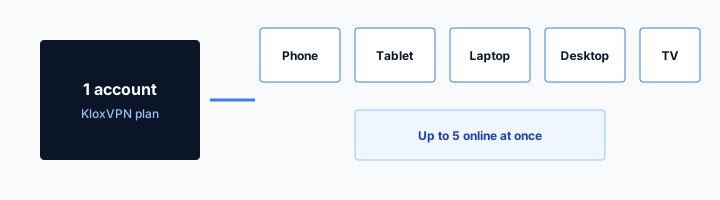
Five devices is a story, not a slogan
Unlimited sounds kind. It is how you fund shared logins. Five concurrent tunnels is a seating chart: two phones, a laptop, a tablet, a spare. Say concurrent, not lifetime activations, if that is what you operate. Users assume the kinder reading. The store review for a sixth-device lie is public.
WireGuard is table stakes. Showing up is not.
Buyers have heard of WireGuard. They have not heard of your 11 p.m. reply. Position on the protocol only if the app actually offers it and you can say what you use when WireGuard is blocked. For us that spare tire is OpenVPN. If your brand hides OpenVPN to look 'modern,' you will earn tickets that say the product is broken. They are right.
Our consumer price is a reference
Reseller is different: you send people to Klox prices. White-label: your merchant, your rate. I will not applaud a $0.99 experiment on a hosted stack. I will applaud a $6 household SKU with a help center that matches the app. The number is allowed to be yours.
Position as the inbox that answers
Most consumer VPNs cannot win a protocol war against each other in a landing-page paragraph. They can win 'someone replied in my language before I disputed.' That is a position. It costs wages. Put it on the site only if it is true on a Tuesday.
Macros for public Wi-Fi, device limits, and failed cards will cut volume. They will not delete physics. If you staff one person for eight thousand bargain subscribers, you will have a graveyard of slow first responses. Slow first responses become one-star copy that follows your ads around.
I would rather you raise a dollar and hire the second inbox person than stay cheapest and answer in three days. Users who leave over a dollar were going to leave over a hotel portal anyway. Users who stay notice that someone answers.
Language is a moat you can actually own
English landing pages are a commodity. Support in the language your ads use is not. If you buy traffic in a market where the giants answer slowly or in English only, that is a position. Price for it. Do not then staff the inbox with a translator plugin and hope.
Hours of coverage beat a fake SLA
Do not publish '24/7' if you mean a mailbox that opens at 9. Publish the hours. A smaller brand that tells the truth about hours looks more adult than a giant that lies about chat. Adult is a position.
Household product versus bargain bin
Families buy a seating chart. Bargain hunters buy a weekend. If you want households, talk like a household: who gets a slot, what happens when a kid's tablet stays connected overnight, how to drop a traded-in phone. That copy is positioning. It is also ticket prevention.
If you want weekend travelers only, say so with a monthly SKU and a refund window that matches a trip. Mixing 'family plan' language with a $1.99 race trains the family to expect bargain support. They will not get it. They will review you.
Klox consumer five-device framing is a household product. Your white-label brand can steal the framing without stealing the price. Steal the honesty. Leave the unlimited fantasy on the competitor's page.
Kids and shared iPads
Family plans fail when one child signs the parent out. Make the active-device list obvious. This is retention, not a feature launch. It is also how you avoid a ticket that starts with 'I paid and now I am locked out of my own account.'
Do not whisper a sixth device in ads
Affiliates love 'unlimited.' If your app says five, your ads say five. The mismatch is a refund machine. Position as clear limits. Clear limits feel like a product. Mystery limits feel like a scam even when you are honest in the terms nobody read.
Protocols as proof, not poetry
A VPN wraps traffic in a tunnel. Cloudflare's explainer is enough for a buyer who wants the idea. IETF RFC 8446 is TLS 1.3, which is the kind of boring document you cite when you mean encryption is a real thing, not a badge. Neither document makes your brand special. Shipping WireGuard, OpenVPN, OpenConnect, and Shadowsocks in the same app, and telling people when to use which, does.
Position: 'fast path when the network is normal, stubborn path when the network is rude.' That is an opinion a traveler can test. 'Next-generation stack' is a press release. I will not help you write the press release.
Do not cripple a cheap SKU
Hiding OpenVPN on the door-buster plan creates tickets that say the product is broken. Feature-identical plans with different billing periods are a product. Lite versus Ultra where Lite cannot connect on hotel Wi-Fi is a trap. Traps get screenshotted.
Dedicated IP is a different position
If you sell dedicated IP, you are in allowlists, mail, and banking tickets. That is a premium position with a premium inbox. Do not bolt it onto a bargain homepage to look complete. Completeness is how you drown.
Refunds as brand, not coupon bait
Klox consumer uses seven days. That is a window we can execute the same way at 11 p.m. A 30-day window on a floor price is an invitation to use the product as a free month with extra steps. Require a card if you trial. Rate-limit farms without calling it surveillance.
Refund professionals can smell a new brand. A written policy, trained, is cheaper than founder exceptions that become case law in chargeback land. Fast refunds inside the window prevent disputes. Slow refunds 'to save money' buy you a processor letter.
Position: 'we will let you leave quickly if this is not for you.' That sentence converts people who have been burned. It also filters people who wanted a free month. Good.
Partial refunds on annual
Decide up front: full inside the window, then none, or pro-rata. Pro-rata sounds fair and creates math arguments. Full-then-none is cleaner if the window is short. Publish it. Do not invent a third policy for a user with a large following.
Lifetime deals are a position you will hate
A lifetime SKU is infinite service obligation on today's hosting and today's contract. Lifetime users will still be in the inbox in 2029, citing a launch-week comment. I would not sell lifetime on a young white-label. If you already did, honor it and stop expanding it.
What you should never copy from a discounter
Struck-through fantasy MSRP. Fake 'you save 94%' math. Countdown timers that reset. Unlimited devices you cannot operate. 'No logs' copied from a company that runs its own nodes. SOC 2 badges you did not earn. We do not invent SOC 2 for Klox in this article and you should not invent it for your brand either.
Copy the discounter's landing-page structure and you will inherit their buyer. Then you will wonder why your 'premium' help center is full of coupon tickets. The structure taught them who you are.
Affiliate evergreen codes
A 40% code that never dies is a second price list. It becomes the real price. Either publish it or stop. Evergreen codes also train affiliates to only push when a coupon is live. That is a fragile company.
Review-site poetry
Paid roundups will call you the best VPN for a country you barely serve. Do not quote that on your homepage. Quote what you can show: devices, protocols, refund window, hours. Boring proof beats rented superlatives.
Niche, bundle, and who you are for
An ISP, a hotel group, or an MSP can charge more than a generic English page because the buyer is not shopping a coupon grid. The premium is the inbox and the existing relationship, not a new handshake. Position as 'this is part of the service you already pay us for.' Then actually include it in the retainer or the room rate so the ticket has a home.
If you bundle VPN with a password manager and an 'AI privacy' widget, you just opened three support queues. Position as one extra thing you operate, or do not bundle. Suites that hide a weak VPN price inside a weaker stack get hated for the weakest piece.
Reseller is a position too
Selling Klox under the Klox name is a calmer job. You do not get to invent a $0.99 Klox SKU. Your money is the program economics. If this article made you want a brand and an inbox, that is white-label. If it made you nauseous, stay reseller until you want the mess. There is no shame in that.
Geographic honesty
Do not position as a local operator if the company, the merchant, and the support hours are all somewhere else and you will not say so. Local language plus honest entity is a position. Fake local is a trust hole.
A positioning worksheet that is not a price worksheet
Write these sentences before you buy ads. (1) Who is this for in one household or one job, not 'everyone who wants privacy.' (2) What we will not do (unlimited devices, 30-day free, 24/7 if you mean 9–5). (3) What a buyer can check in five minutes (device list, protocol switch, refund page). (4) What a ticket looks like in week one and who owns it. (5) What we will still be in month four when the coupon dies.
If you cannot fill (4) and (5), you are launching a campaign, not a brand. Campaigns can still make money. They should not wear a company name you care about.
Then pick a price that pays for (4). The other article in this series has the arithmetic. This one only cares that the arithmetic and the homepage tell the same story. I keep a fourth test that founders skip: would you still run this brand if paid ads got 40 percent more expensive next quarter? If the answer is no, you were never positioned. You were rented. Rented demand is allowed. It should not be the only reason the company exists. Owned demand looks like returning users, a help center people actually open, and a name people type without a coupon code. That takes time. Time is why cheap races feel attractive. They fake the first month and steal the fourth.
Homepage test
Show the real number. Show devices. Show the refund window. Show protocols you ship. Link terms. If a stranger cannot tell you apart from a $1.99 clone in ten seconds, you are the clone. Fix the sentences, not the gradient.
Ad test
If the ad would still work with a competitor's name swapped in, it is not positioning. It is a bid. Bids are fine. Do not confuse them with a brand. I would rather a smaller, true ad than a big, interchangeable one.
Month-four test
Launch week lies. Month four is when monthlies renew or do not, when annual users still remember they paid, and when your macros have holes. If you positioned for a spike, you will feel poor here. Watch tickets per net add, not just checkout conversion.
What 'premium' is allowed to mean
Premium is a ruined word in VPN. It usually means a gradient and a fake MSRP. I will allow it to mean three things only: a human answers, the client still connects on a rude network, and the refund lands when you said it would. If you cannot point at those, do not say premium. Say cheap, or say household, or say local language. Those are positions a buyer can test.
A lot of white-label launches try to look like a consumer giant in week one: 94% off, a world map, a blog that reprints the same five FAQs. Giants can lose money on year one. You cannot see their blended cost of acquisition. Copying their costume is how small brands donate cash to ad networks and then blame the platform when the inbox explodes.
Position against the giant by being specific. Five devices, named. WireGuard, OpenVPN, OpenConnect, and Shadowsocks, named. Seven days, named, if that is your window. Hours of support, named. The giant will still beat you on brand search. They will not beat you on a Tuesday ticket in a language they staff poorly — if you actually staff it.
Maps are not a position
A server map is expected. It is not why someone stays. People stay because the app reconnects after a subway tunnel and because cancel did not feel like a maze. If your homepage is 80% map, you are still competing as a commodity. Shrink the map. Enlarge the sentences a tired parent can use.
Do not rent a personality
Edgy Twitter, stoic privacy monk, neon gamer — pick one that matches who you will still answer. A gamer brand with a 9–5 inbox is a lie. A privacy monk brand with Google Analytics soup on every page is a lie. Personality is positioning only if operations match.
Key Takeaways
Being cheapest is easy to announce and expensive to operate. Position is the set of checkable promises you can still keep when the tunnel has a bad day: five devices if that is the product, WireGuard, OpenVPN, OpenConnect, and Shadowsocks if that is what the app ships, a refund window a human can execute, an inbox in the language of the ads.
Klox consumer from $2.83 a month is a reference for a complete SKU, not a script your white-label brand must copy. You set the rate. You also set the review score, because the rate chose the mix.
Fill the positioning worksheet. Publish one honest page. If the only story you have is a race to the floor, do not launch a brand. Resell Klox, or pick a different product. If you want your name on the client and a price your inbox can survive, talk to us about white-label and bring the worksheet, not just a coupon idea.
Related Resources
Build a brand that can answer the ticket
White-label: your name, your rates, Klox network. Consumer Klox remains from $2.83 a month with five devices, WireGuard, OpenVPN, OpenConnect, and Shadowsocks, and a seven-day window — a reference, not your mandate.
Talk to us about white-labelFrequently Asked Questions
KloxVPN Team
Experts in VPN infrastructure, network security, and online privacy. The KloxVPN team has been building and operating VPN services since 2019, providing consumer and white-label VPN solutions to thousands of users worldwide.