
The billing essay is about whether the spreadsheet survives. This is about the sentences you send when a card dies, when someone hits cancel, and when you want them back without sounding like a 14-email drip written by a bored model.
I have watched brands paste the same block into three jobs. "We miss you. Our servers are blazing. Military-grade. No logs ever." That paragraph is how you train users to ignore you, then dispute you. A failed renewal is an operations event. A true cancel is a product event. A win-back is a bet. If you use one letter for all three, you will recover fewer cards and create more tickets that quote your own mail as a lie.
KloxVPN consumer is WireGuard, OpenVPN, OpenConnect, and Shadowsocks, five devices, from $2.83/month on yearly, 7-day money-back. Your white-label brand sets retail, the refund window, and the from-line. None of that gives you permission to invent a logging claim in a recovery email that your privacy page does not support. None of it lets you promise a city list you copied from a competitor homepage.
I am not going to give you a magic sequence that "adds 12% recovered MRR." I do not have your processor mix, your descriptor, or your audience. I will give you the distinctions that keep copy honest and keep support from rewriting your campaign at 11 p.m.
If you wanted unit economics (annual vs monthly, tax, chargebacks as a P&L line), that is the other article. Stay here if you write the emails, own the ESP, or approve the macros. The tunnel is still a VPN. The letter is still a legal-ish object. Treat it like one.
A VPN subscription is easy to forget. People install for a trip. They keep the icon. The bank declines a merchant that looks like "privacy software." Or they cancel because the hotel portal fought WireGuard and nobody told them OpenVPN exists. Those are different humans. They need different first sentences.
Write the jobs on a whiteboard: update card, confirm cancel, invite back, do not lie. If a draft cannot tick one job, delete it. Content-farm copy tries to do brand, upsell, and fear in the same 90 words. That is how you sound like every other inbox the user already muted.
Related reading: White-Label VPN and Store Preview Video and White-Label VPN and Billing Churn Margins. Billing a White-Label VPN: Cards, Tax, and Failed Payments and Positioning a VPN Brand Without Being the Cheapest. What is a VPN? and Download KloxVPN.
Looking for a reliable VPN?
KloxVPN — from $2.83/month. Apps for every device.
Failed card is not a breakup
Involuntary churn is a polite name for "the bank said no." The user may still want the app. They may not know the charge failed. If your first email sounds like a breakup ("We're sorry to see you go"), you have already classified them as gone. That classification leaks into support macros and into how you report "churn" to yourself.
Soft declines (insufficient funds, try again later) want a retry schedule and a calm update-card link. Hard declines (stolen, do not honor, account closed) want a stop, a portal, and no 45-day retry loop. Mixing those two is how you annoy issuing banks and users in the same week.
I like day 0, day 3, day 7 for soft declines, then pause access and send a clean "we stopped trying" note. Your processor may already retry. Your email should not contradict the retry. If access is still on during grace, say so. If it is paused, say so. Mystery lockouts create chargebacks that quote "I thought I was cancelled."
The statement descriptor belongs in the first paragraph. Last four of the card if you have them. Plan name. Amount. Date you will pause. One button. Not a PDF of "how billing works." VPN users are trained to treat random payment mail as phishing. Same domain as the app. Same brand as the icon. No red URGENT in 18pt.
This is not a margin lecture. It is a copy lecture with an ops spine. If you cannot name who is merchant of record, you should not send dunning until that paragraph exists in checkout. The Stripe billing piece covers who charges. This piece covers what the human reads.

- 1Skim the seating / order diagram.
- 2Do the numbered steps once on your real network.
- 3Use the FAQ if a sentence was too long.
- 4Follow one related article — not ten tabs.
How to read this page
| Job | User intent | First sentence job | Do not say |
|---|---|---|---|
| Failed card (soft) | Still a customer if the charge works | Charge failed; update card by DATE | We miss you / you left us |
| Failed card (hard) | Card is dead | We stopped charging; here is the portal | We will keep trying for 45 days |
| True cancel | They asked to leave | You are cancelled; here is the date access ends | Are you sure? 12 reasons to stay |
| Win-back (later) | They already left | Optional offer with a real end date | Our logs never exist / 10 Gbps guaranteed |
| Refund window | Clock is running | How to request; what you will pay | A different window than the site |
If the email could be sent by a vitamin brand with the product name swapped, delete it.
— KloxVPN operator notes
Cloudflare Learning: What is a VPN?
Wikipedia: Virtual private network
Grace is a published rule, not a vibe
Pick a grace window and put it where support can find it. I like 3 to 7 days of retries with access still on, then pause, then cancel if you must. Infinite grace creates freeloaders and confused tickets. Instant lock on first decline creates chargebacks from people who would have updated the card on Thursday.
Klox consumer money-back is 7 days on first purchase. That is not your white-label refund policy unless you set it. Do not paste 7 days into a dunning mail if your checkout says 14. Support will spend the morning reconciling your ESP with your lawyer.
Pause beats cancel-plus-resubscribe
A pause keeps the account identity, device list, and coupon history. A cancel plus new signup splits that history and can look like velocity fraud to a processor. Prefer pause during dunning. If you cancel, say the word cancel in the email so they do not think you stole a month.
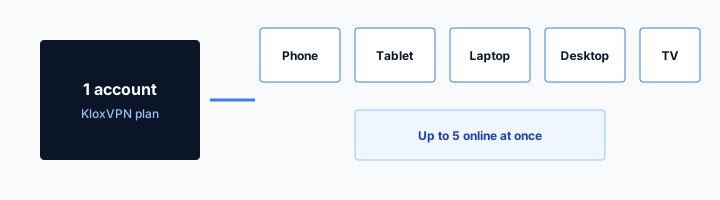
Device count belongs in the portal, not in the dunning letter, unless they hit a lock because of it. Five devices is the Klox consumer cap. Your brand may differ. Confirm. Do not lecture them about WireGuard in a card-failed mail. They cannot connect if they cannot pay.
True cancel is a different letter
When someone hits cancel, they are not a failed Visa. They made a choice. The adult move is: confirm the cancel, name the date access ends, name whether the period already paid still works, link a receipt, stop selling in the same paragraph.
Guilt sequences ("Was it something we said?") belong in a survey 24 hours later if you must, not in the confirmation. Confirmation mail is a legal-ish receipt. Keep it boring. Boring reduces "I never cancelled" tickets and "I cancelled and you charged me" tickets.
If you offer a pause instead of cancel, offer it once, with a real duration, not an infinite "we'll hold your account in a drawer." If you discount to save them, name the new price and the term. Mystery discounts train people to cancel for a coupon every year.
I would rather lose a user cleanly than keep them with a trap. Traps show up in app-store reviews and in chargeback reason codes. VPN is already a high-forgetfulness category. Adding a maze is how you become a case study in a consumer blog you will hate.
The save offer that is allowed to exist
A one-time pause, a switch from annual to monthly, or a honest "tell us if the hotel Wi-Fi blocked UDP and we will point you at OpenVPN" is a save. A 12-slide carousel of fear is not. If the product failed on a captive portal, fix the help article and mention the fallback protocol. That is product. That is not a content farm.
Annual prepaid cancel is a refund conversation
Monthly cancel is mostly access-end date. Annual cancel is money. Say whether unused months are refundable. If they are not, say that in the same sentence as the cancel button, not three emails later. Klox consumer yearly effective rate is $2.83/month. Your brand's annual is yours. The copy rule is the same: the checkout and the cancel mail must agree.
Win-back timing that does not feel like a farm
Win-back starts after cancel is real, not during dunning. If you mix "update your card" with "we miss you," you sound confused. I would wait until access has actually ended, then optionally send one short note, then maybe one more after a few weeks. Not a 14-touch novel.
Hours after cancel: they are still in the emotional event. A receipt is enough. Days later: a single useful thing (OpenVPN on hotel Wi-Fi, kill switch left on, device limit) if that was the ticket theme. Weeks later: a real offer with an end date, or silence.
Silence is a valid strategy. Not every churned user is a campaign. Privacy-minded users treat extra mail as a logging signal. That is unfair to your ESP, and it is still how they feel. If your brand promised quiet, keep the list quiet.
I do not like "we noticed you haven't connected in 30 days" as a win-back hook unless you already disclose connection metadata in the privacy page. If you do not store that, do not pretend you "noticed." If you do store it, say what you store, in the same nouns as the policy. Do not get cute.
One job per send
Update card. Or confirm cancel. Or invite back with a dated offer. Or point at one help article. Not all four. Content farms stack jobs because the template has slots. You do not have to fill slots.
Unsubscribe is part of the product
A win-back that cannot be refused is a support ticket. One-click unsubscribe. Honor it. If you cannot honor it because your ESP is a mess, fix the ESP before you scale ads. VPN users will screenshot the footer.
What you may say about the tunnel
You may say you offer WireGuard, OpenVPN, OpenConnect, and Shadowsocks if that is what the apps actually ship. You may say five devices if that is the plan they bought. You may say money-back if that is still true for their purchase type. You may link the live server map rather than inventing cities in the footer of an email.
You may not promise that every cafe will handshake. You may not promise a streaming catalog. You may not promise that a bank will love a shared exit. You may not promise "military-grade" as if that were a SKU.
Cloudflare's explainer and Wikipedia exist so a new marketer can remember what a VPN is. RFC 8446 is TLS 1.3 on the web. NIST SP 800-77 is a public IPsec guide. None of those documents are your win-back proof. Do not paste RFC numbers into a "we miss you" letter. It reads like a student who found Google.
If a node was actually sick when they left, you may say you had an incident and here is the status habit you use now. If you did not have an incident, do not invent one to sound humble. Fake postmortems are worse than silence.
Protocol fallback is a useful sentence
A lot of true cancels after travel are UDP blocked on campus or a hotel portal that hates WireGuard. "Try OpenVPN" is a real sentence. It belongs in help and sometimes in a save offer. It does not belong in every dunning mail. Match the sentence to the ticket theme if you have one. If you do not have one, do not guess they left because of protocol.
Point at the live map, do not mint cities
Klox publishes a live list on the VPN server locations page, with 100+ locations and 60+ countries in existing site language. Your white-label footprint is whatever the contract says. An email that lists 94 city names you copied from a competitor is how you get a complaint when one pin is wrong. Link the map. Do not write a gazetteer.
Logs and the sentence that gets you sued
Win-back copy loves "we never log anything." That sentence is either already on your privacy page in careful nouns, or it is a lie with a from-line. Do not invent a stricter claim in an email than you make on the site. Emails get forwarded. Lawyers read forwards.
If the brand is not the network operator, first-person "we don't log packets" is a trap. The no-logs-when-brand-isn't-the-operator article exists for that. In mail, link the policy. Do not improvise.
Account data is not traffic data. You probably have an email address. You probably have a billing record. Saying "we know nothing about you" while sending a personalized dunning mail is comedy. Users notice.
I will not put SOC 2 in a recovery email. I will not invent an audit firm. If you have a real attestation, sales can share it under NDA. A churn letter is not a trust center.
What "we noticed" requires
If you say you noticed they did not connect, you are claiming a connection record. If your policy says you do not keep that, pick a different hook. "Your subscription ended on DATE" is enough. It uses billing, which you already have.
Do not scare them with the cafe
Fear copy ("hackers on public Wi-Fi") in a win-back is how you sound like 2014 affiliate pages. If they cancelled, they already heard the pitch. Offer a concrete fix or a dated price. Or stop.
Speed claims in a recovery mail are how you train chargebacks
Nobody can honestly promise that their tunnel will be faster than the hotel ISP. WireGuard is often quicker to handshake and lighter on CPU than a heavy OpenVPN profile. That is a real sentence. "10x faster" in an email is a future dispute.
Streaming "unblock" in a win-back is worse. CDNs change. Shared exits get hot. If they left because Netflix buffered, a letter that swears it is fixed will be quoted when it is not. Invite them to test during a money-back window if you still offer one. Do not swear.
Competitor speed pages are theater. I linked a big consumer brand as sponsored promo on purpose. Do not clone their adjectives into your ESP. Their ads are not your evidence pack.
A testable invite beats a trophy
"Come back for 7 days, here is how refunds work" is testable if that is your policy. "We are the fastest VPN in 2026" is not. Klox consumer has 7-day money-back. Your white-label window is yours. Only mention it if it still applies to returning users. Returning users are often excluded. Say so.
Five devices is a household fact, not a boast
If they left because a sixth phone kicked someone off, say what the cap is and what happens at the limit. Do not pretend unlimited. Do not upsell in the same sentence as a failed-card dunning. One job.
From-line, domain, and phishing training
VPN users click less. They should. Your mail must look like the app. Brand name in the from-line. Domain you control. SPF, DKIM, DMARC that actually pass. A cheap ESP on a shared domain is how your dunning lands next to a fake "Klox billing" phish.
If the charge says one name and the email says another, you will get "I never bought this." Fix the descriptor first. Then align the from-line. Then send.
Do not use URL shorteners. Do not attach a random APK. Do not ask them to reply with a screenshot of the full card. Portal link, logged in, last four, done.
White-label makes this worse if the platform still sends mail. Who owns the mailbox is an ownership question. Inherit-vs-own covers the map. Here the rule is simple: the user paid a brand. That brand's domain should send the billing mail. If it cannot, say so in the first onboarding mail so they are not shocked.
Test a live $1 on your own phone
Before you scale a sequence, subscribe with your own card, fail a renewal in test mode or with an expired test card if the processor allows, and read the mail on LTE, not on office Wi-Fi. If it looks like a scam to you, it looks like a scam to them.
Support must be able to search the send
When a user forwards a dunning mail and says it is fake, support needs a message-id and a template name. If your ESP cannot do that, you will refund out of fear. That is a staffing cost hiding in copy ops.
Measurement without fake percentages
Track recovered cards, unsubscribes, tickets that quote the email, chargebacks in the 7 to 90 days after a send, and whether pause vs cancel changed the story. I will not invent a recovery rate for your brand. Processors differ. Audiences differ.
If recovered MRR goes up and chargebacks go up more, you did not win. If unsubscribes spike after a "we noticed you," you probably claimed metadata you should not have used as a hook.
Do not A/B fear versus calm with a sample so small the winner is noise. Do not put "winner" in a Slack trophy. Put the chargeback rate next to it.
This is still not the unit-economics article. I am not calculating contribution margin on a dunning send. I am telling you which numbers lie if you only watch open rate. VPN mail open rates are junk anyway. People preview. People block images.
Tickets that quote you are a copy bug
If support keeps answering "your email said no logs / unlimited speed / we paused you but the app still billed," the template is wrong. Fix the template. Do not hire another agent to apologize for marketing.
Refund window mail is a clock
During money-back, the job is how to get the money, not a win-back novel. Fast payout. Same window as the site. Klox consumer is 7 days. Yours may not be. Agents should not invent a third window in chat.
White-label: whose brand owns the mailbox
On hosted white-label, you still own the customer. The platform can tell you a node is sick. It should not send "we miss you" from a domain the user does not recognize. Confirm who sends transactional mail in the contract. Confirm who sends marketing mail. Those are different permissions.
If you resell Klox instead, you are in a different motion. Commission, less mailbox, less win-back of "your" brand. Do not run a win-back sequence for a product whose statement descriptor you do not control.
Admin API jobs (create, disable, export) are not email copy. Do not invent paths in a footer. Confirm with sales. This article will not mint a REST route so your wiki looks complete.
Retail price is yours. From $2.83/month is Klox consumer yearly, not a mandate for partners. If you discount in win-back below a floor you cannot staff, you will earn a user you cannot afford to talk to.
Macros and ESP must share nouns
If the help center says OpenVPN and the email says "our next-gen protocol," agents will contradict the campaign. Same words as the app. WireGuard. OpenVPN. Five devices or whatever you sell. Money-back days. Pause. Cancel.
Do not outsource the from-line to a content mill
A vendor who has never used the app will write "empty privacy poetry" and you will have to fire them. Write the three letters in-house once. Then let a vendor format. Not the other way around.
A one-page brief before anyone hits send
Before a sequence goes live: job (card, cancel, win-back). Merchant of record name. Descriptor. From-line domain. Grace days. Pause vs cancel. Refund window for that SKU. Whether returning users still get money-back. What the privacy page actually says about connection metadata. Protocol names you are allowed to use. Link to the live server map, not a pasted city list. Who can unsubscribe. Who answers if the mail is forwarded as a phish.
If a line is blank, do not send. Blank lines are how content farms ship.
I would rather you send two honest emails than eleven clever ones. The tunnel still has to handshake. OpenVPN still exists for hostile portals. WireGuard is still the usual default. None of that belongs in a vitamin-style "we miss you." Put the physics in help. Put the money facts in the letter. Put the fear copy in the trash.
What never belongs
Invented SOC 2. Invented uptime. Invented city counts. Invented API paths. "We never log" if the policy is narrower. Speed trophies. Streaming guarantees. Fake scarcity ("only 4 hours left" on a digital SKU you will still sell tomorrow).
What always belongs in failed-card mail
Who charged. How much. Which plan. How to update the card. When access pauses. How to reach a human on the same brand domain. That is the whole product for that send.
Key Takeaways
Failed cards get a payment letter. True cancels get a receipt. Win-back is optional, late, and short. If a draft could run for a mattress company, it is not a VPN letter.
Do not invent logs, speed, cities, or certifications to fill a template. Link the privacy page you actually published. Link the live map if placement matters. Name WireGuard, OpenVPN, OpenConnect, and Shadowsocks only if the apps ship them. Name five devices and $2.83/month and 7-day money-back only when you are talking about Klox consumer, or when your white-label SKU truly matches.
The margin article is the spreadsheet. The Stripe article is who charges. The staffing article is who answers when the letter creates a ticket. This one is the sentences. Write the one-page brief. Then send fewer emails than the content farm told you to.
Related Resources
Own the mailbox. Keep the copy boring.
White-label puts your brand on the Klox network. You still write dunning, cancel, and win-back. Confirm who sends mail, then write three honest letters.
Talk to us about white-labelFrequently Asked Questions
KloxVPN Team
Experts in VPN infrastructure, network security, and online privacy. The KloxVPN team has been building and operating VPN services since 2019, providing consumer and white-label VPN solutions to thousands of users worldwide.